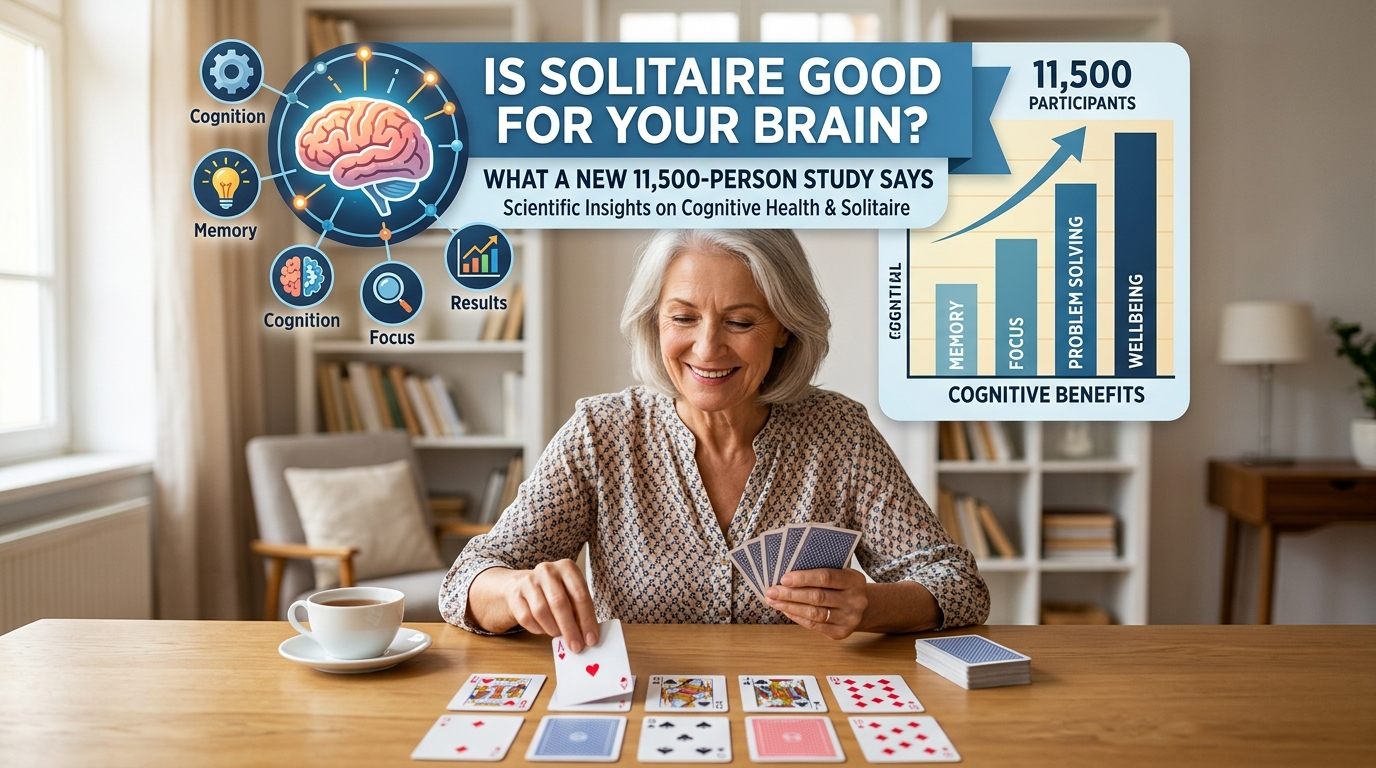
Solitaire and Your Brain: What the 11,500-Person Active Brains Study Says
A large new trial suggests that staying mentally active can reduce cognitive impairment in older adults. It's good news for anyone who plays cards to keep their mind sharp, but the study didn't test solitaire. Here's what it found, what it can't tell us, and how to use solitaire as part of a mentally active routine.
This article isn't medical advice. If you're worried about your memory or someone else's, the person to talk to is a doctor.
What the Active Brains study actually found
The Active Brains trial was led by the University of Southampton and published in The Lancet Primary Care on 28 September 2026. It followed more than 11,500 people aged 60 to 85 who had cognitive impairment, recruited through GPs and nurse practitioners, and tracked them for 12 months.
Participants were split into three groups:
- Control group: tested, asked about their activities, and given brief advice on physical activity, diet and brain-stimulating activities.
- Website group: given access to a website of brain exercises and advice.
- Website plus support: given the website and offered two brief appointments, calls or emails from a facilitator, usually a nurse.
Compared with the control group, the website group had an 8 percent reduction in the number of people with mild cognitive impairment. The group that also had facilitator support had an 18 percent reduction. The activities encouraged included puzzles, online brain-training games, playing an instrument, singing in a choir, learning a language and social activities.
Two details are easy to miss. First, the control group improved too: after 12 months, 28 percent of them no longer had cognitive impairment. The 8 and 18 percent figures are the extra benefit on top of that. Second, the researchers noted that most participants already had reasonably healthy activity levels and diets, so the results may not apply equally to everyone. The university's press release is the source for these numbers, and you can read it here.
Where solitaire fits (and what the science doesn't say)
Here's the honest part. The study didn't test card games, and solitaire isn't mentioned among the activities it lists. It tested a package of brain-stimulating activities delivered through a website, plus advice. Nothing in it shows that playing solitaire prevents or reverses cognitive decline.
What it does support is a general idea: regular, varied mental challenge seems to be worth doing. Solitaire is a reasonable member of that family. It asks you to plan, remember and make decisions, it's easy to fit into a day, and it's enjoyable enough that people actually keep doing it. That last point matters more than it sounds, because the best mental activity is the one you'll stick with.
So treat solitaire as one good habit among several, not a treatment. The same study encouraged physical activity, a healthy diet and social contact, and those matter at least as much as any game. For a longer look at what the wider research does and doesn't support, see our guide to the cognitive benefits of solitaire.
The mental skills solitaire exercises
Planning ahead
Almost every good solitaire move comes from looking a few steps ahead. Before you move a card you ask what it will uncover, what it will block and what you'll do next. Games like FreeCell, where every card is visible from the start, turn that into a pure planning puzzle.
Working memory
You have to keep track of which cards are buried, which have already gone to the foundations and what the stock is likely to hold. Remembering the waste pile order in Klondike, or the order of the cards you've seen, gives your short-term memory a real workout.
Focus and patience
A game takes ten minutes or so of sustained attention with no notifications. For many people that quiet, single-task focus is a rare thing in itself, and it's a skill that improves with practice.
Flexible thinking
When a plan fails you have to adjust. Deciding when to abandon a line of play, undo a move or try a different approach is exactly the kind of flexibility mentally active people try to keep.
A variant ladder: from easy to demanding
Mental activity helps most when it's challenging but achievable. If every game is an easy win, or a frustrating loss, you stop learning. Here's a ladder you can climb as you improve:
- Klondike 1-Suit. A gentle start with fewer constraints on where cards can go. Good for getting comfortable with the layout. Play Klondike 1-Suit.
- Klondike, Draw 1. The classic. Colours and suits matter, but the stock is forgiving. Our Klondike rules guide covers the setup, and beginner tips help early on. Play Klondike.
- Klondike, Draw 3. Harder, because you only reach every third card and need to track what's buried in the stock. See Draw 1 vs Draw 3.
- Spider. Two decks and long sequences that demand sustained focus. Start with one suit and read the Spider rules. The two-suit and four-suit versions found elsewhere are the real test. Play Spider.
- FreeCell. Nearly every deal is winnable, but only if you plan carefully, which makes it the best pure planning exercise of the lot. Our FreeCell guide explains how it works. Play FreeCell.
Move up when wins start to feel routine, and drop back down if a level makes the game stressful rather than interesting.
Tips to keep your games challenging
- Think before you click. Scan every available move first, as you would on a hard puzzle, instead of making the first obvious one.
- Limit undos. Treat undo as a last resort. Having to live with a decision is what makes you plan.
- Vary your games. Switching between Klondike, Spider and FreeCell exercises different skills, in the same spirit as the varied activities in the study.
- Set yourself small goals. Win in fewer moves, beat your best time or try a daily seeded deal and compare your result.
- Keep sessions short and regular. A few games most days are easier to sustain than a long session once a week.
- Mix in other activities. Walking, music, learning something new and seeing friends all came up in the research, and they pair well with a daily game.
Frequently asked questions
Is solitaire good for your brain?
It's a mentally active game that exercises planning, memory and focus, so it's a sensible part of a mentally active routine. No study has shown that solitaire on its own prevents or reverses cognitive decline.
What did the Active Brains study find?
Among more than 11,500 older adults, a brain-activity website reduced mild cognitive impairment by 8 percent compared with the control group, and the same website with brief facilitator support reduced it by 18 percent, over 12 months.
Which solitaire game is best for memory?
The one that is challenging but winnable. FreeCell rewards planning, Spider demands focus and Klondike Draw 3 adds uncertainty. Start easier and move up.
Is solitaire good for seniors?
Many older players enjoy it because it's solo, self-paced and low-stress. It works best alongside physical activity, social contact and other mental challenges.