12 Solitaire tips for beginners: win more games starting today
The biggest beginner mistake in Solitaire is moving cards to the foundations too early. Before anything else, focus on turning over face-down cards in the tableau — that's where games are actually won or lost, not on the foundations.
Most new players treat the foundations as the goal and work toward them constantly. That's right eventually, but wrong right now. Every face-down card you flip gives you more options. Rushing cards to the foundations before the tableau is organized usually leaves you stuck with fewer moves than you started with.
Why beginners lose at Solitaire
Most beginner losses come down to the same two or three mistakes. Moving cards to the foundations the moment it's legal, without asking whether it actually helps the board. Ignoring face-down tableau cards — treating them as obstacles instead of the game's main resource. And drawing from the stock before checking whether tableau moves exist that would open things up.
None of these are hard to fix. They're mostly about changing what you pay attention to first. The tips below work through each one.
12 beginner tips for winning Solitaire
1. Scan all possible moves before making any
Before you touch a card, look at the whole board. Check every tableau column, the waste pile, and your foundation options. It sounds obvious, but most beginners spot the first legal move and take it. The first legal move is almost never the best one.
A full board scan takes maybe 10 seconds. The players who improve fastest are the ones who genuinely pause before every move, even when the game feels obvious. It doesn't feel like much, but that 10-second habit changes how the game goes.
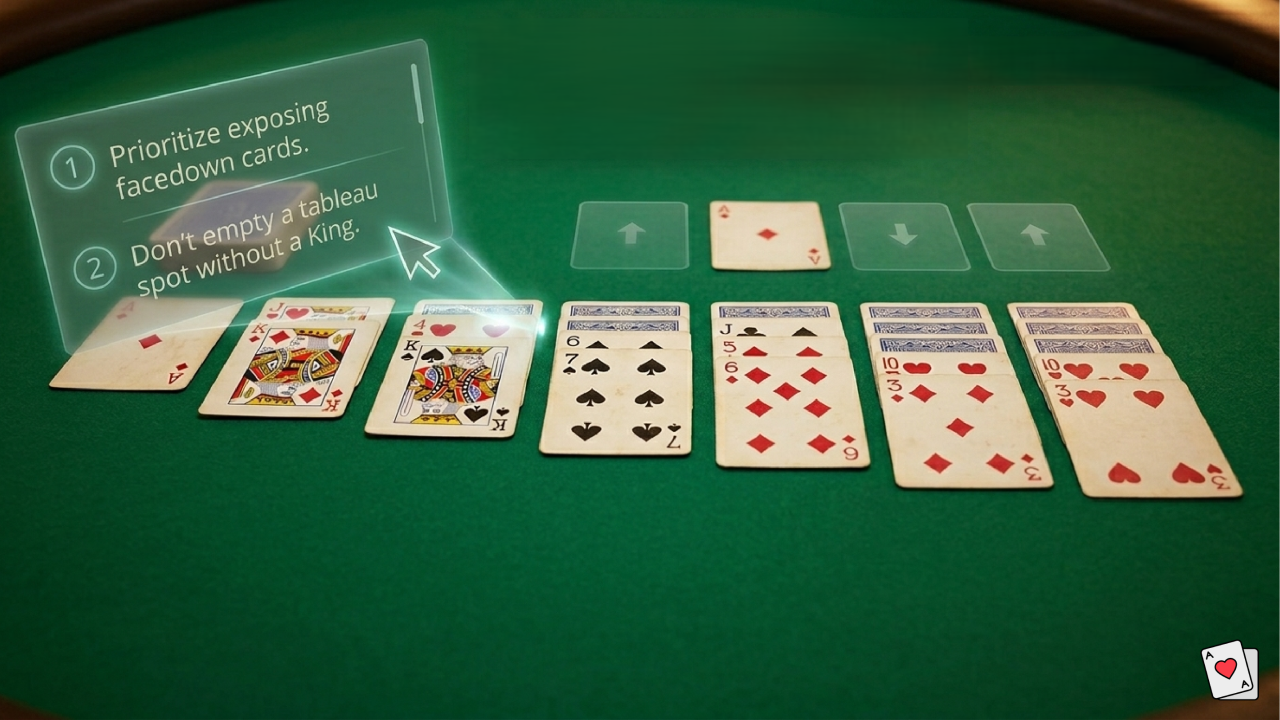
2. Expose face-down cards first — always
When you have a choice of moves, take the one that flips a face-down card. Every face-down card is a locked option — you can't plan around what you can't see. Flipping one costs a single move and might open up several more.
Columns with the most face-down cards are the most important. A column with six face-down cards and one face-up card has six moves you can't see yet. Getting into that column is usually worth more than a clean, visible move somewhere else.
3. Don't empty a column unless you have a King ready
Empty columns are the closest thing Solitaire has to a wild card. They're temporary holding space for cards you need to rearrange, and they're the only way to break apart sequences that are blocking each other. The problem is they're easy to fill and hard to recreate.
Only Kings can go in empty columns. If you clear a column without a King ready, you've created a space you can't use — and you may have reshuffled other positions to get there. Before emptying a column, know which King is going in, and ideally what sequence you're building underneath it.
4. Build foundation piles roughly evenly across suits
This one surprises people. Racing one suit to King while the others sit at 3 or 4 is usually a mistake. A lot of tableau moves depend on temporarily parking a card on a foundation and pulling it back. Once a foundation pile is deep and the others aren't, that flexibility disappears.
Keeping all four foundations within 2–3 ranks of each other gives you more places to stash cards temporarily. It also avoids the situation where you need a specific low card to bridge a tableau gap but it's already buried on a foundation pile with no way back.
5. Prioritize tableau columns with the most face-down cards
Not all columns are equal. A column with five face-down cards locks more of the game than a column with one. The deeper the pile, the more it's constraining your options. Pointing your moves at exposing those deep columns first gives you the best shot at opening up the game before the stock runs dry.
That doesn't mean ignoring everything else. Sometimes a move in a shallow column creates the sequence you need to get into a deeper one. But when you have a genuine choice, favor depth over tidiness.
6. Know when to draw from the stock
Draw from the stock after you've used up your tableau moves, not before. The stock isn't going anywhere. If you draw early with two or three good tableau moves still available, you're skipping information the board is giving you for free.
Sometimes drawing is the only option. That's fine. But if you're clicking the stock while valid moves are sitting in the tableau, you're playing on autopilot. Check the tableau first, every time, and only draw when you're genuinely out of moves.
7. Use undo without guilt
Undo in digital Solitaire isn't cheating. Physical cards don't let you take moves back, but you're not playing physical cards. When a sequence of moves leads to a stuck position, undo back to where the road forked and try the other path. You'll start to recognize which patterns lead to dead ends without having to play them out each time.
Over dozens of games, exploring alternatives this way builds pattern recognition faster than grinding each game straight through. The goal isn't to finish every game without undoing anything — it's to understand the game well enough that you eventually don't need to.
8. Use the hint system to learn, not just to get unstuck
Most Solitaire implementations include hints. Using them when you're stuck is obvious. What's less obvious is using them early in a game, when you already have a move in mind, just to see whether the hint agrees with you.
When it suggests something different, figure out why. The priority order hints use — foundations first, then moves that flip face-down cards, then tableau rearrangements — is the same order experienced players follow without thinking about it. Watching hints over many games is a fast way to get that order into your instincts.
9. Play Easy mode while learning
Easy mode is designed to produce deals where the Aces and low cards are accessible — games that reward good play instead of punishing a brutal shuffle. While you're still building the basics, Easy mode cuts down on games where you're stuck before you've made ten moves.
Once you're winning more than half your Easy mode games, switch to Medium. Good play on Easy can get you to an 80%+ win rate. When you're consistently around 55% and the game feels comfortable, that's a reasonable time to move to the standard shuffle.
10. Start with Draw 1 before trying Draw 3
Draw 3 looks like a minor variation. It isn't. Drawing three cards at a time means most of the stock is effectively buried — you can only see one card per cycle, and getting to a specific card you need might take several full passes through the deck. That's a real planning burden on top of everything else.
Draw 1 shows you cards one at a time, which keeps the feedback loop tight. You can react to what you draw without having to think three cycles ahead. Get comfortable winning Draw 1 games before trying Draw 3. Going straight to Draw 3 as a beginner mostly produces games that feel random, because there's a skill gap you haven't filled yet.
11. Alternating colors — check both ways
The tableau builds down in alternating colors: red on black, black on red. New players often scan in one direction only and miss moves as a result. A black 7 can go on a red 8, yes — but a red 7 can also go on that black 8 you're staring at.
When you're scanning, ask both questions: "What can go on top of this card?" and "Where can this card go?" The second one gets skipped more often, especially when you're focused on placing something specific rather than reading what the board will accept.
12. Learn to recognize when a game is unwinnable
About 21% of standard Klondike deals are mathematically unwinnable. No amount of good play solves them. Part of getting better at Solitaire is learning to spot a dead deal early rather than spending another 20 minutes on it.
The warning signs: all four Aces buried deep with no visible path to them, same-suit cards blocking each other in circular ways, and two or more full stock cycles with nothing to show on the foundations or face-down piles. When most of those are true at once, the deal is almost certainly gone. Deal again. There's nothing wrong with cutting your losses on a bad shuffle.