FreeCell Solitaire: complete rules, strategy & tips
FreeCell is the only mainstream Solitaire variant where almost every deal is winnable. Out of the first 32,000 numbered deals, only one — deal #11,982 — is known to be unsolvable. When you lose at FreeCell, it's almost always because of a decision you made, not the hand you were dealt.
Klondike has a real luck component: about 21% of deals are mathematically unwinnable regardless of skill. Spider depends on the round deals landing well. FreeCell strips all of that away. All 52 cards are face-up from the first move. What you do with that information is entirely on you.
How to set up FreeCell
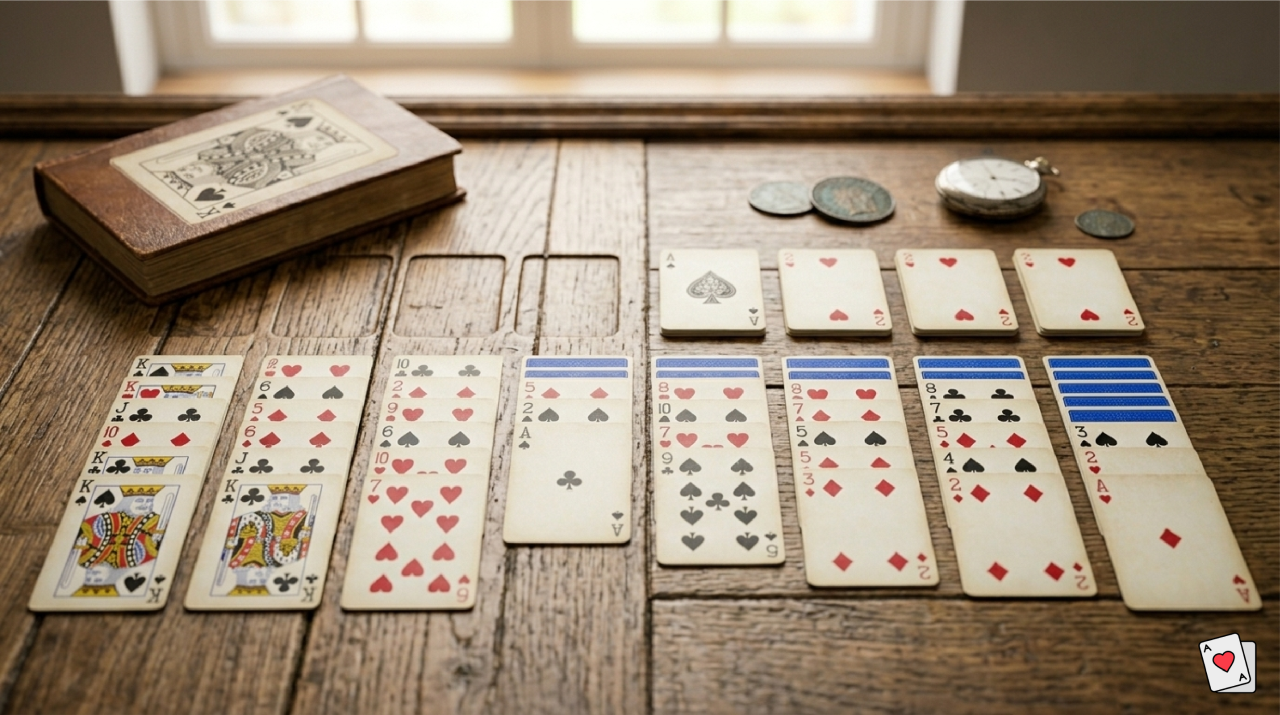
FreeCell uses a single 52-card deck dealt across 8 columns. The first four columns get 7 cards each; the last four get 6 cards each. All cards are dealt face-up. Nothing is hidden.
Above the tableau sit two areas. On the left are the four free cells — the defining feature of the game. Each free cell holds exactly one card. They're your temporary parking spaces: move a card there when it's in the way, retrieve it when the timing is right. On the right are the four foundation piles, one per suit. You win by building each foundation from Ace to King.
That's the entire board. 8 columns of face-up cards, 4 free cells, 4 foundations. No stock pile. No cards you haven't seen. The game is already fully laid out when it begins.
FreeCell rules
The tableau
In the tableau columns, cards are built down in alternating colors — the same rule as Klondike. A black 7 can go on a red 8. A red Queen can go on a black King. Empty columns can accept any card or sequence.
The free cells
Any single card can be moved to an empty free cell at any time. Cards in free cells can be moved to the tableau (if a legal move exists) or directly to a foundation. A free cell holds exactly one card. Four free cells means you can park up to four cards at once — use them carefully, because running out is usually fatal.
The foundations
Foundations are built up by suit, starting from Ace. The Ace of Spades starts the spades foundation; the 2 of Spades goes on it next, and so on up to the King. Once a card goes to a foundation, it stays there. You win when all 52 cards are on the four foundations.
Moving sequences
Technically, FreeCell only allows you to move one card at a time. But most implementations — including this one — support moving a properly-ordered sequence in a single action, provided you have enough free cells and empty columns to do it legally.
The rule behind this is called the supermove. The maximum number of cards you can move in one sequence is:
(number of empty free cells + 1) × 2number of empty columns
With 2 empty free cells and 1 empty column, you can move up to 6 cards at once: (2 + 1) × 2 = 6. With no empty free cells and no empty columns, you can only move 1. Empty columns make an enormous difference to what's possible, which is why getting one open and keeping it that way matters more than almost any other single decision.
FreeCell strategy
Plan before you move
In Klondike, you can often improve your position by making any reasonable-looking move. In FreeCell, impulsive moves are what lose games. Because every card is visible, there's no excuse for not looking 3–4 moves ahead before touching anything. Before making a move, ask: what does this enable, and what does it block?
This is especially important early. The first five moves in FreeCell often determine whether the game is winnable from that point on. A sequence you create in the opening can become a wall that traps key cards for the rest of the game.
Free the Aces and 2s first
Nothing can go to the foundations until the Aces are free. If an Ace is buried four cards deep in a column, getting it out is your first job — even if it means using free cells or disrupting a sequence you'd rather not touch.
The 2s follow directly from the Aces, so cards blocking 2s are almost as urgent. A buried 2 that you can't reach quickly turns into a long chain of cards that can't move to the foundation, and the whole game stalls.
Guard your free cells
Using all four free cells feels freeing in the moment — until you realize you can only move one card at a time with nothing left to park. Two or three cards in free cells is manageable. Four is a warning sign. Filling all four with no clear plan to empty them is usually the beginning of a stuck game.
A useful test: before moving a card to a free cell, know where it's going next. If the answer is "I'll figure it out later," that card will probably sit there until it becomes a problem.
Create empty columns, then protect them
An empty column is very useful. It works like a free cell for any card (not just single ones) and doubles your supermove capacity. The problem is that empty columns attract cards — filling them just because you can is a hard impulse to fight. An empty column you've just filled with a tidy-looking sequence is far less useful than one you keep open for actual maneuvering.
Sometimes the right play is to use an empty column temporarily during a complex sequence move, then leave it empty again afterward.
Build foundations evenly
Don't rush one foundation to King while the others lag behind. If your spades foundation is at 9 and the others are at 3, cards that belong on the other foundations can't move, which means the tableau gets clogged. Aim to keep all four foundations within 2–3 ranks of each other. A card that goes to the foundation now clears the board; a card that could go but you're blocking is just waste.
Identify buried cards early
Before making your first move, scan the full board. Look for Aces, 2s, and 3s buried deep under higher-value cards — those are your real constraints. The obvious sequences you could start building usually aren't the problem. It's the low card stuck under five cards of no use that will kill the game ten moves later if you ignore it now.
Common mistakes
Moving Aces and 2s to free cells
A card in a free cell is available to move — including to a foundation. But if an Ace is sitting in a free cell when it could already be on a foundation, you're wasting a parking space on a card that has a permanent home. Aces and 2s should be heading to foundations, not sitting in free cells waiting.
Building long sequences in the wrong direction
A long tableau sequence looks satisfying, but if the bottom card of that sequence is something you need to access soon, you've just buried it. Before building a long sequence, check whether the bottom card (the one that will be deepest) is needed elsewhere in the near term.
Filling the only empty column
You've worked hard to empty a column. Then a move presents itself that fills it with a tidy-looking sequence. Now you have zero empty columns, your supermove capacity is halved, and any complex sequence you wanted to execute later is now impossible. Empty columns are worth protecting even when filling them looks locally correct.
FreeCell win rate
Skilled FreeCell players win 90–95% of games. Beginners typically win 40–60%. That gap is almost entirely strategy — specifically, planning depth and free cell discipline. Unlike Klondike, where some losses are just bad luck, almost every FreeCell loss is traceable to a decision.
Of the standard 32,000 numbered FreeCell deals (a common range used in implementations since Windows 95), only deal #11,982 has been proven unsolvable by exhaustive computer analysis. All others have at least one winning line of play. This doesn't mean they're easy — just that a solution exists.
That's the appeal: FreeCell is hard because it's demanding, not because it's unfair.
FreeCell vs Klondike
The most important difference isn't the free cells — it's the information. In Klondike, roughly half the cards start face-down. You're guessing. In FreeCell, you see everything from move one. This changes what kind of thinking the game rewards.
Klondike rewards adaptability and probability judgment: you make the best move given incomplete information, then adjust as more cards reveal themselves. FreeCell rewards analysis and planning: you solve a puzzle you can fully see, and every mistake is one you could have avoided.
Players who like feeling clever tend to land on FreeCell. Players who want some luck in the mix tend to prefer Klondike. I find FreeCell more satisfying to win precisely because you can't blame the deck when you lose — every loss has a move somewhere that you could have played differently.
How FreeCell got popular
FreeCell was created by Paul Alfille in 1978 while he was a medical student at the University of Illinois. He wrote the first computerized version for a PLATO terminal — an early educational computer network — and it quietly gathered an audience among students who had access to the system.
It stayed obscure until 1995, when Microsoft included it in Windows 95. Unlike Klondike (which had been in Windows since version 3.0), FreeCell was new to most people. The numbered deals, the face-up layout, and the near-perfect solvability made it distinctively compelling. It built a serious following through the Windows era and has remained one of the most-played Solitaire variants ever since.