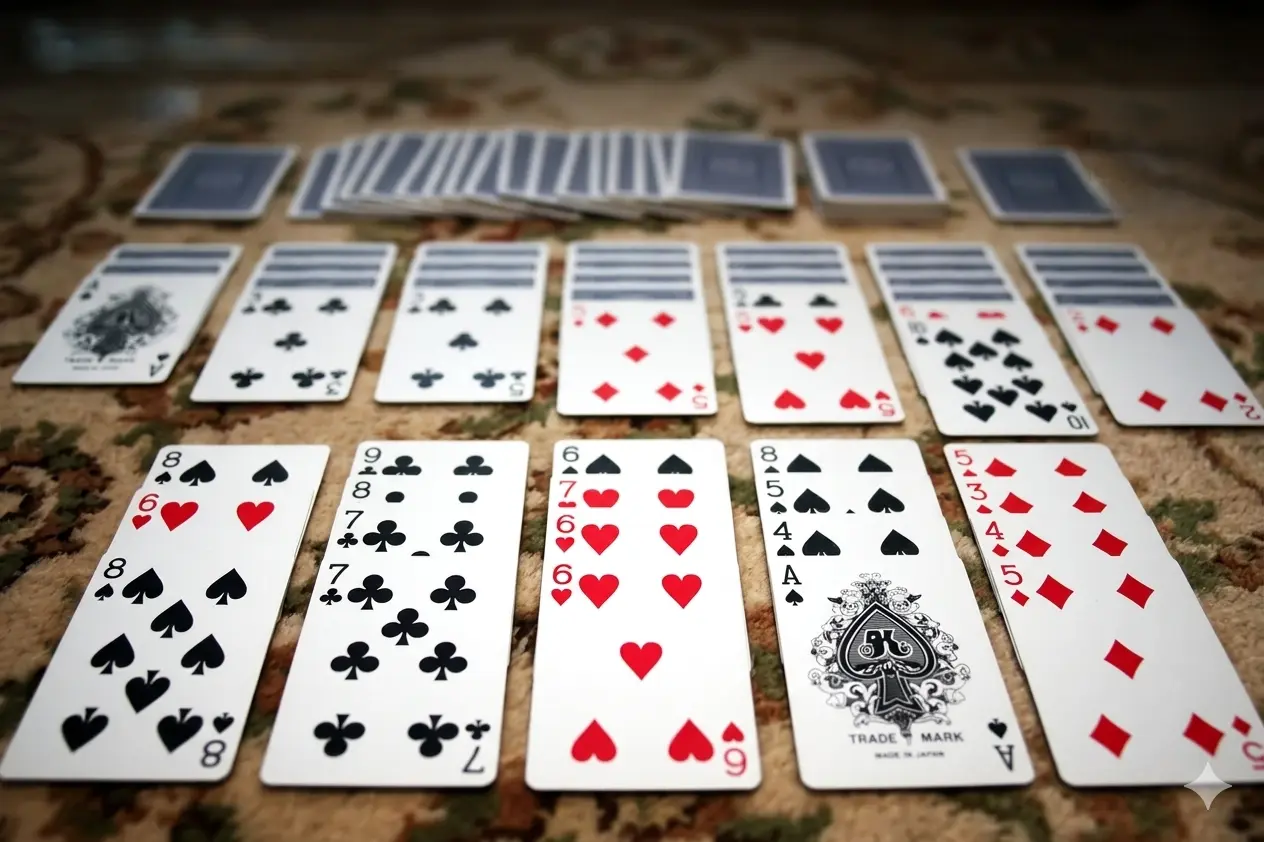
How to Play Spider Solitaire: Rules, Setup & Strategy Guide
Spider Solitaire uses two decks and 10 columns. Build a complete King-to-Ace run of the same suit, and it's automatically cleared from the board. Do that 8 times and you win. The setup sounds manageable. The challenge is that 104 cards across 10 columns get chaotic fast, and every deal from the stock buries whatever progress you've made.
If you know Klondike, Spider will feel familiar in some ways and completely different in others. No waste pile, no separate foundations — everything happens on the tableau.
Spider Solitaire setup
Spider uses two standard 52-card decks (104 cards total). At the start:
The tableau (10 columns)
- The first 4 columns each get 6 cards
- The remaining 6 columns each get 5 cards
- 54 cards total are dealt to the tableau
- Only the top card of each column is face-up
The stock pile
- The remaining 50 cards form the stock
- The stock deals 10 cards at once — one to each column
- 5 deals are available before the stock runs out
The rules
Moving cards
Move a face-up card from the top of any column to another column, as long as the card you're placing is one rank lower than the card it lands on. A 7 goes on an 8. A Queen goes on a King. Aces are the lowest card and can't be built on.
In Spider 1 Suit, suit doesn't matter for placement — any card of the right rank can go anywhere. In 2-suit and 4-suit variants, suit restrictions apply when moving groups (though single cards can still move freely).
Moving sequences
You can pick up and move a group of cards as a unit, but only if they form a clean descending sequence of the same suit. In Spider 1 Suit, since every card is a spade, any tidy descending run qualifies. A mixed-up column — even if it's descending — is locked. You can only move cards off the top one at a time.
Flipping face-down cards
Move the top card or sequence off a column and the card beneath automatically flips. This is the core loop of Spider. You're constantly trying to uncover what's hidden.
Completing a sequence
When a complete King-to-Ace sequence of the same suit sits at the top of any column, it's automatically removed from the board. You need to complete 8 of these to win.
Dealing from the stock
When you run out of moves, deal from the stock. One card goes face-up to each of the 10 columns simultaneously.
Two things to know:
- You can't deal if any column is empty — all 10 must have at least one card first
- Each deal buries whatever sequences you've been building under a new layer
With only 5 deals in the whole game, each one matters. Scan all 10 columns carefully before dealing. Missing one move and burning a deal early is how games unravel.
What is Spider Solitaire 1 Suit?
Spider comes in three variants. The difference is how many suits are in play:
| Variant | Suits used | Difficulty | Sequence rule |
|---|---|---|---|
| 1 Suit | Spades only | Easiest | Rank only — suit doesn't matter |
| 2 Suit | Spades & Hearts | Medium | Sequences must match suit to move as a group |
| 4 Suit | All 4 suits | Hardest | Strict suit matching required throughout |
In Spider 1 Suit, every card is a spade, so you can place any card of the right rank on any other, and any descending run moves together. The suit constraint that makes 2-suit and 4-suit so punishing simply doesn't exist here. It's the cleanest way to learn how Spider actually works before the harder variants add complexity on top.
How to win at Spider Solitaire
Legal moves and good moves are not the same thing. Most losses in Spider come from making moves that were technically allowed but strategically pointless.
Uncover face-down cards first. Face-down cards block everything beneath them. In the early game, focus on the columns with the most hidden cards. One good sequence of moves that flips three cards beats shuffling tidy stacks around all day.
Keep your sequences clean. A descending run moves as a unit. A column where the order got broken is stuck — you can only peel cards off the top. Once a column gets messy, untangling it costs more moves than it's worth.
Empty columns are your most valuable resource. Getting a column completely clear mid-game opens up card rearrangement that isn't possible otherwise. When you get one, use it to set up a sequence completion, not just to temporarily park something inconvenient.
Go slow with the stock. Every deal dumps 10 new cards on top of whatever you've built. Some of those cards will land badly. Check every column twice before dealing — once for obvious moves, once for less obvious ones.
Use undo without guilt. Spider is a game of order, and order depends on sequencing. Trying moves in different orders often produces completely different results. Undo a sequence, try it differently, see what opens up.
Spider vs Klondike: the main differences
| Feature | Spider (1 Suit) | Klondike |
|---|---|---|
| Decks | 2 decks (104 cards) | 1 deck (52 cards) |
| Columns | 10 | 7 |
| Win condition | 8 complete K–A sequences removed | All 52 cards on 4 foundation piles |
| Stock dealing | 10 cards at once to all columns | 1 or 3 cards to a waste pile |
| Foundation piles | None — sequences auto-remove | 4 piles (Ace to King by suit) |
| Color matching | No (1-suit variant) | Yes — alternating red/black |
| Difficulty | Medium | Easy (Draw 1) to Hard (Draw 3) |
The main thing Klondike players notice: there's nowhere to put cards except the tableau. No waste pile, no separate foundations to send things to. Completed sequences vanish on their own, which feels satisfying, but getting there means managing 10 columns at once with nowhere to offload cards you're not ready to use.
Frequently asked questions
How do you play Spider Solitaire?
Deal 54 cards across 10 columns (top card face-up). Move cards in descending order to build sequences. Complete a King-to-Ace sequence of the same suit to remove it. Deal from the stock when stuck (5 deals available). Win by removing all 8 sequences.
What is the goal of Spider Solitaire?
Complete 8 King-to-Ace sequences of the same suit. Each one is automatically cleared when it forms. Clear all 8 and you win.
What is Spider Solitaire 1 Suit?
Two decks, all spades. Because every card is the same suit, you don't need to worry about suit matching when placing cards or moving groups. It's the simplest version of Spider and the right place to start.
Is Spider Solitaire harder than Klondike?
Spider 4 Suit is much harder than Klondike. Spider 1 Suit is roughly comparable to Klondike Draw 1 — more manageable, though it requires a different kind of planning. If you win Klondike Draw 1 without much trouble, Spider 1 Suit will give you something new to think about.
Can every Spider Solitaire game be won?
No. Some deals are unwinnable regardless of how you play, especially with 2 and 4 suits. In 1 Suit more deals are solvable, but plenty aren't. A loss doesn't always mean you made a mistake.
What happens when the stock runs out?
After all 5 deals, no more cards come. You win if you complete all 8 sequences, or lose if you run out of useful moves with cards still on the board.
Can I undo a completed sequence?
Once a King-to-Ace sequence is cleared from the board, those cards are gone. Undo can reverse it, but only if you act immediately before making another move.