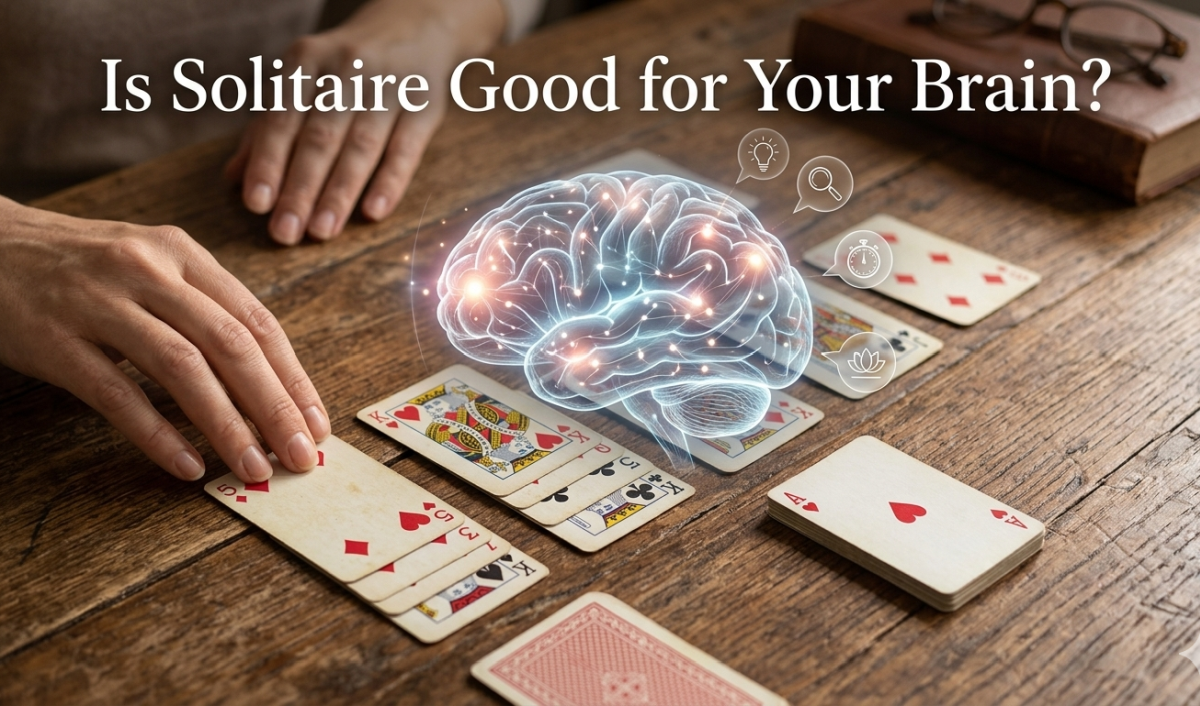
Is Solitaire good for your brain? The cognitive benefits of card games
Solitaire exercises working memory, pattern recognition, and decision-making under uncertainty. Whether that translates to long-term cognitive improvement is harder to measure, but as a mental activity, it's doing more than most passive entertainment. It demands active attention in a way that watching a show or scrolling a feed simply doesn't.
The honest answer to "is Solitaire good for your brain?" is: yes, in the ways most mentally engaging games are, but don't expect miracles. The evidence for brain training games producing generalized cognitive improvements is mixed at best. What we do know is that Solitaire puts real cognitive demands on working memory and planning, and those demands have worth even if they don't turn you into a better chess player.
Is Solitaire good for your brain?
The short answer: yes, in a modest but real way. Solitaire is an active cognitive task. You're holding multiple states in mind simultaneously, updating your model of the board as cards are revealed, planning ahead under uncertainty, and making decisions with incomplete information. That's a meaningful mental workout.
The longer answer involves some necessary skepticism. The "brain training" industry has a poor track record of producing games that improve cognition beyond the specific task you're practicing. Getting better at Solitaire doesn't straightforwardly make you better at unrelated cognitive tasks. If you're hoping Solitaire will prevent cognitive decline or sharpen your memory for work, the evidence for that specific claim is thin.
What's on firmer ground: Solitaire engages cognitive systems that benefit from regular use, the relaxation it provides is real and not trivial, and it's considerably more mentally demanding than most other ways people spend equivalent time. Those are genuine benefits, even if they're modest ones.
6 cognitive benefits of playing Solitaire
1. Works your working memory
Working memory is the cognitive system that holds information in mind while you use it, like mentally tracking a phone number while you dial it. Solitaire puts a sustained load on working memory throughout each game.
At any point in a Klondike game, you're tracking which columns have face-down cards and roughly how many, what's in the stock and waste pile, where each suit's foundation currently stands, and which sequences you've been building. None of that information is stored in a single place on the board. You have to maintain a mental model of it and update that model as moves are made.
This isn't passive. Every time you draw from the stock and mentally note "that's the 7 of clubs, I need that for column 4 but it's blocked by the 8 of diamonds," you're exercising working memory. The task is small, but it repeats constantly throughout the game.
2. Builds pattern recognition
Experienced Solitaire players spot useful sequences and problem patterns faster than beginners, and this is almost entirely pattern recognition at work. After enough games, you stop consciously thinking through "does this card go here?" and just see it, the way a chess player recognizes a fork without calculating.
This is a well-documented feature of skill acquisition across domains. Practice doesn't just make you faster at conscious reasoning. It automates common patterns so they require less mental effort. The result is cognitive capacity freed up for higher-level planning.
In Solitaire specifically, this shows up as quicker recognition of stuck positions (and the ability to avoid them), faster identification of which moves expose the most face-down cards, and pattern detection in the stock cycle that helps predict when a needed card will be accessible.
3. Requires strategic thinking and planning ahead
Good Solitaire play isn't reactive. It's forward-looking. Moving a card is easy; understanding what that move unlocks 3 moves from now is the actual skill.
The planning demands in Solitaire are genuine. Before emptying a column, a skilled player has already thought through which King goes there, what sequence that King enables, and whether the tableau position after those moves is better or worse than the current position. That chain of reasoning (consequence mapping, in the jargon) is the same cognitive process used in programming, project planning, and strategy games.
It's not chess-level planning depth, but it's not trivial either. Especially in Spider 4-suit, where sequences must be same-suit, planning 8–10 moves ahead is often necessary to avoid dead ends. That's a real planning workout.
4. Teaches patience and emotional regulation
This benefit gets less attention than the memory and planning angles, but it's real. Klondike deals you an unwinnable game roughly 1 in 5 times. You don't know it's unwinnable when you start. Grinding through a game for 15 minutes only to hit a true dead end is frustrating, and learning to recognize that frustration, sit with it, and make a calm decision about whether to continue is a form of emotional regulation practice.
There's also the patience of Draw 3 mode, where the card you need is visible in the waste pile but three cards below the accessible one. Waiting for the right moment, cycling the stock again rather than forcing a suboptimal move, requires tolerating uncertainty without acting impulsively. That's a transferable skill.
5. Provides low-stress cognitive stimulation
Not all brain engagement needs to be intense to be worthwhile. Solitaire occupies your mind in a gentle, self-paced way. There's no timer (in standard play), no opponent, no stakes. You can stop mid-game, come back later, and resume without penalty.
This makes it well-suited for situations where you want your mind engaged but not taxed: a coffee break, a waiting room, the post-lunch slump. The cognitive demand is real but doesn't require the focused intensity that, say, reading dense nonfiction does.
For older adults especially, this balance matters. High-intensity cognitive tasks can feel exhausting or discouraging. Solitaire sits in a useful middle ground: more engaging than watching television, less demanding than a crossword puzzle with difficult clues.
6. It's genuinely relaxing, and that matters too
Cognitive restoration theory, developed by Rachel and Stephen Kaplan in the 1980s and 1990s, proposes that certain types of activities restore directed-attention capacity. Directed attention is the effortful focusing you use for demanding work. It depletes over time and needs to be restored.
The activities that restore it best are ones that engage attention without demanding it: nature walks, listening to music, gentle physical activity. Card games like Solitaire occupy a similar space. The game holds your attention without the strain of forced concentration. You're engaged, but the engagement is comfortable.
This isn't pop psychology. The restorative function of engaging-but-low-stakes activities is fairly well established. Playing Solitaire for 20 minutes when mentally tired may genuinely improve your subsequent focus on demanding tasks, not by making you smarter, but by giving your directed-attention capacity time to recover.
Solitaire for seniors: why it's well-suited
Solitaire has been popular with older adults since long before smartphones, and the reasons make sense. The game is self-paced with no time pressure in casual mode. It's familiar, too: a large proportion of people over 50 played it on Windows in the 1990s and already know the rules without needing to learn anything. There's no social pressure or competitive element to feel anxious about.
The cognitive engagement level is appropriate for a wide range of ability. Someone with mild cognitive difficulties can still enjoy it in ways they might not manage with a more complex game. Someone in full cognitive health finds enough strategic depth to stay interested. It scales in both directions without anyone feeling excluded.
There are also social and engagement benefits worth acknowledging. Daily login streaks, leaderboards, and win-rate tracking give the game a light social layer and a sense of progress. For people who live alone or have reduced social contact, the minor daily ritual of checking a streak or seeing their name on a leaderboard provides a small but real sense of connection and continuity.
The accessibility is important too. Digital Solitaire is free, requires no installation beyond a browser, and works on devices most people already own. The barrier to entry is lower than almost any other cognitively engaging activity.
How much Solitaire should you play?
20–30 minutes per day is probably where the benefit-to-cost ratio is best. That's enough time to play several complete games, engage the cognitive systems meaningfully, and get the relaxation benefits, without crossing into the territory where you're substituting Solitaire for more important activities.
Beyond an hour, you're likely past any meaningful cognitive benefit and into pure entertainment. That's entirely fine. Entertainment has its own worth. But be honest about what you're getting out of it: playing Solitaire for three hours in a single session is enjoyable, and the cognitive return diminishes sharply after the first 30–45 minutes.
The research on habitual cognitive engagement suggests that consistency matters more than volume. Daily light engagement probably does more for long-term cognitive health than occasional heavy sessions. A 20-minute daily habit is worth more than a 2-hour session on the weekend.
Solitaire vs other brain-training games
Crosswords exercise verbal memory and word retrieval, which is a very different cognitive profile from Solitaire. They're better for language-related skills and worse for spatial reasoning and planning. Many people find crosswords more socially acceptable to describe as "brain training," but that says more about cultural associations than anything else.
Sudoku is pure logical elimination with no randomness. The skill is recognizing constraint patterns and applying deductive reasoning. It's arguably more "pure logic" than Solitaire but lacks the probabilistic reasoning and working memory load that card games provide.
Chess has the deepest strategic planning requirements of any common game. The cognitive demands at a serious level far exceed Solitaire. But chess requires an opponent, significant time commitment, and a skill level that many people find discouraging to develop. The accessibility gap between chess and Solitaire is enormous.
Solitaire combines luck, planning, and pattern recognition in a way that's accessible to a far wider audience than chess and provides a more varied cognitive workout than either crosswords or Sudoku. It's not the most demanding game you could play. It's one of the most realistic ones to actually keep playing regularly.
The case for playing Solitaire without guilt
A lot of people feel vaguely bad about playing Solitaire, as though it's a guilty pleasure or a waste of time that should be replaced with something more productive. That framing doesn't hold up well under scrutiny.
Compare it to the realistic alternatives for equivalent downtime: social media, most television, news. None of those engage your mind the way a card game does, and at least two of them tend to leave you more anxious than when you started. Against that backdrop, Solitaire looks pretty reasonable. You're making decisions, staying occupied, and finishing the session in a calmer state than the alternatives typically leave you.
The honest take: Solitaire is not going to meaningfully improve your IQ, prevent dementia, or give you a measurable cognitive edge at work. But it engages your mind, provides genuine relaxation, and is about as benign a use of leisure time as exists. If you're enjoying it and it's not displacing sleep, exercise, or genuinely important activities, there's nothing to feel guilty about.
Play the game. It's fine.