Expert Solitaire Strategy: How to Beat Hard Klondike, Spider & FreeCell Deals
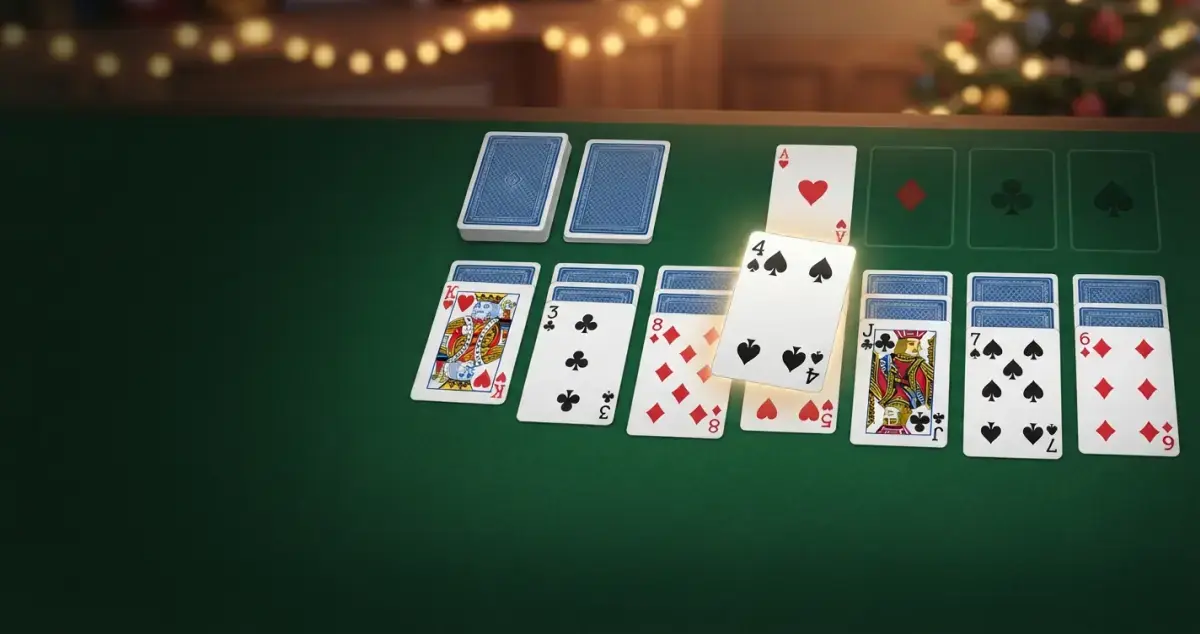
Holiday season is when a lot of players get stuck. Apps roll out seasonal events and expert-level daily challenges, and boards that used to be easy to clear start stalling. If you already win easy and medium deals but keep losing the hard ones, this guide is for you. It covers expert solitaire strategy for Klondike, Spider and FreeCell, with worked examples you can try yourself.
New to a variant? Start with the Klondike rules, the Spider rules or the FreeCell guide first. Unfamiliar terms are explained in the Solitaire Glossary.
What Makes a Deal "Expert"?
Easy deals forgive sloppy play. You can grab the first legal move and still win. Expert deals take that cushion away, usually in three ways:
- Key cards are buried. Aces, low cards and Kings sit under long stacks, so the order you dig in matters.
- Safe moves are rare. Instead of five reasonable options you may have two, and one of them closes off a later move.
- Resources are tight. Empty columns, free cells and stock cycles run out faster, so every one you spend has to earn its keep.
Apps make deals harder in different ways. Some use a harder rule set, such as drawing three cards in Klondike or playing Spider with more suits. Seasonal events and daily challenges often fix the deal for everyone, which means you cannot reshuffle your way out of a bad layout. Check the rules of any event before you start.
One more thing worth knowing: not every deal can be won. In Klondike, some deals are unwinnable from the first card, while in FreeCell nearly all of them can be solved. Our guide on whether every solitaire game is winnable goes through the variants. The tactics below apply either way. They cannot rescue a dead deal, but they keep you from losing a winnable one.
Klondike: Expert Tactics
Many Klondike losses on hard deals come from playing for visible progress instead of hidden information. Experts do the opposite.
Uncover face-down cards first, starting with the longest columns
The longest columns hide the most cards and take the longest to dig out, so start on them early. When two moves are otherwise equal, take the one that flips a card. Our Klondike strategy guide covers the basic priority order.
Do not empty a column unless a King is ready
An empty column accepts only a King. If you clear one with no King available, you have a hole you cannot use, and it may fill with the wrong King later. Before you finish emptying a column, check where your Kings are: face-up in the tableau, in the waste, or still buried. If none can arrive soon, consider working on a different column first.
Think twice before sending cards to the foundation
A card in the foundation can no longer be a landing spot. Low and middle cards are often more useful in the tableau, where a card of the opposite colour and one rank lower can land on them. Foundation moves are rarely urgent. You can usually make them later, but you cannot take them back.
Know how Draw-3 cycling works
In Draw 3, you see only the top card of each group of three, and the order of cards in the stock stays the same from pass to pass. After one full pass you know what is coming. The catch is that playing a card from the waste changes which cards land on top of each group in the next pass. Before you play a waste card, ask which card it will expose and whether that shift helps or hurts. Our Draw 1 vs Draw 3 guide covers the mode differences in more depth.
When two same-colour cards could go, choose the one that opens more options
Say a black 7 is waiting and you hold two red 6s, one in the tableau and one in the waste. Both are legal. Ask which one flips a face-down card and which can wait. The answer is often the tableau card, because it uncovers something.
Worked example: the 5 of hearts
Here is a position where the "obvious" move is wrong.
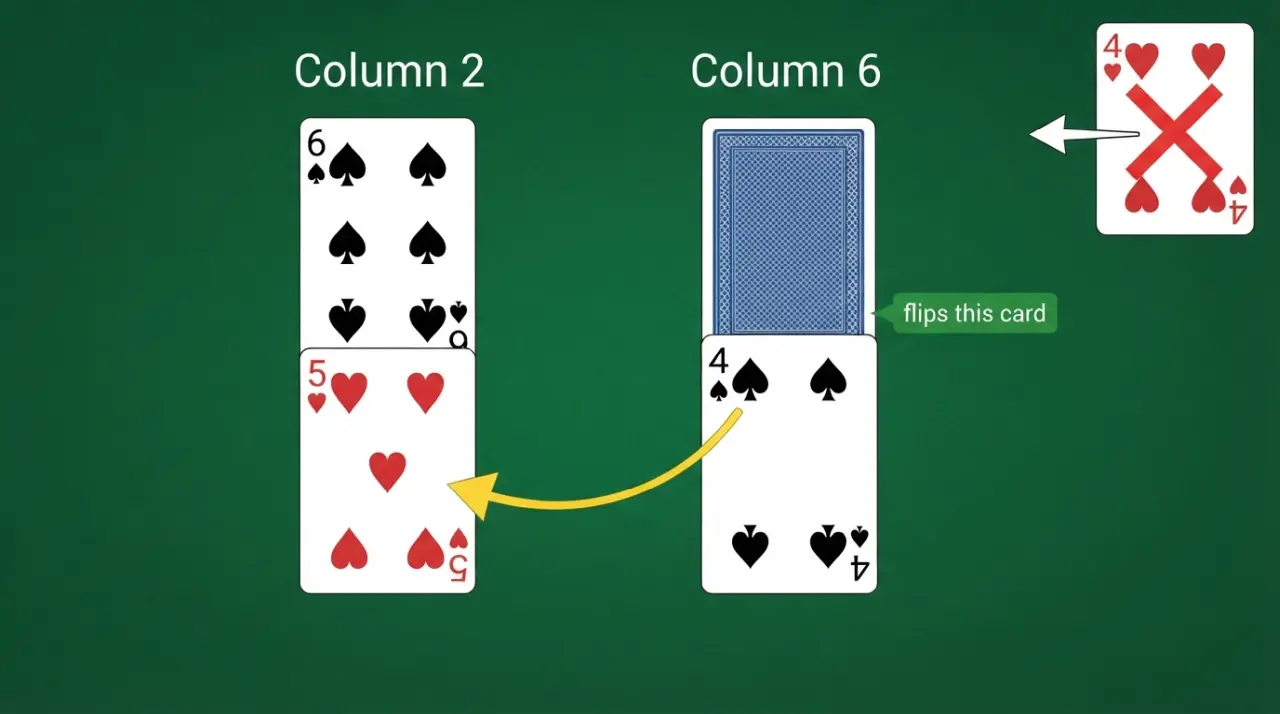
- Foundation: the hearts pile has the Ace through 4.
- Column 2: ends with the 6 of spades, then the 5 of hearts, both face-up.
- Column 6: has one face-down card, then the 4 of spades face-up on top.
- Other red 5: the 5 of diamonds is buried deep in the stock.
The tempting move: send the 5 of hearts to the foundation. It is legal, it feels productive, and the hearts pile grows.
The better move: play the 4 of spades onto the 5 of hearts. That flips the face-down card in column 6 immediately, and the 4 of spades now has a home. If you had sent the 5 of hearts away first, the 4 of spades would have nowhere to go until the other red 5 turned up, and it might never do so in time.
The 5 of hearts is not lost. It can still reach the foundation later, once the 4 of spades has moved on to its own foundation or onto another red 5. You gave up nothing and gained a flipped card.
Pro tip: Before any foundation move, ask one question: "Does a card in the tableau need this card as a landing spot?" If yes, wait.
Spider: Expert Tactics
In Spider, the resources that matter most are empty columns and information. Spend them badly and the board locks up, whatever the number of suits.
Build in suit whenever you can
In Spider you can place a card on any card one rank higher, but you can only move a group of cards together when they are in sequence and in the same suit. A mixed stack is slow to move. Choose same-suit builds even when another legal move looks neater, because the mixed stack you build today is a problem you have to untangle later.
Treat empty columns as your most valuable resource
An empty column is a free staging area for any card or in-suit run. Experts use it to take apart a tangled stack or flip a hidden card, then try to leave it empty again.
Uncover hidden cards before you deal a new row
Dealing from the stock puts a card on every column, which usually buries the card you were about to flip. Spend your moves on hidden cards first and deal only when you are out of useful moves. Many versions of the game also stop you from dealing when a column is empty, so check how your app handles that.
What changes from one to two to four suits
- One suit: every sequence moves as a group, so the puzzle is mostly about uncovering cards and keeping columns open. This is the version on our Spider page.
- Two suits: suit now matters. Choose the build that keeps suits together, and avoid burying a card of one suit under a long run of the other.
- Four suits: clean runs are scarce, so you move more cards one at a time. Empty columns matter even more, and you often need to accept a mixed stack for a while so that you can fix it later. This is where spider solitaire 4 suit strategy becomes careful sequencing rather than quick play.
Worked example: where does the 7 of hearts go?
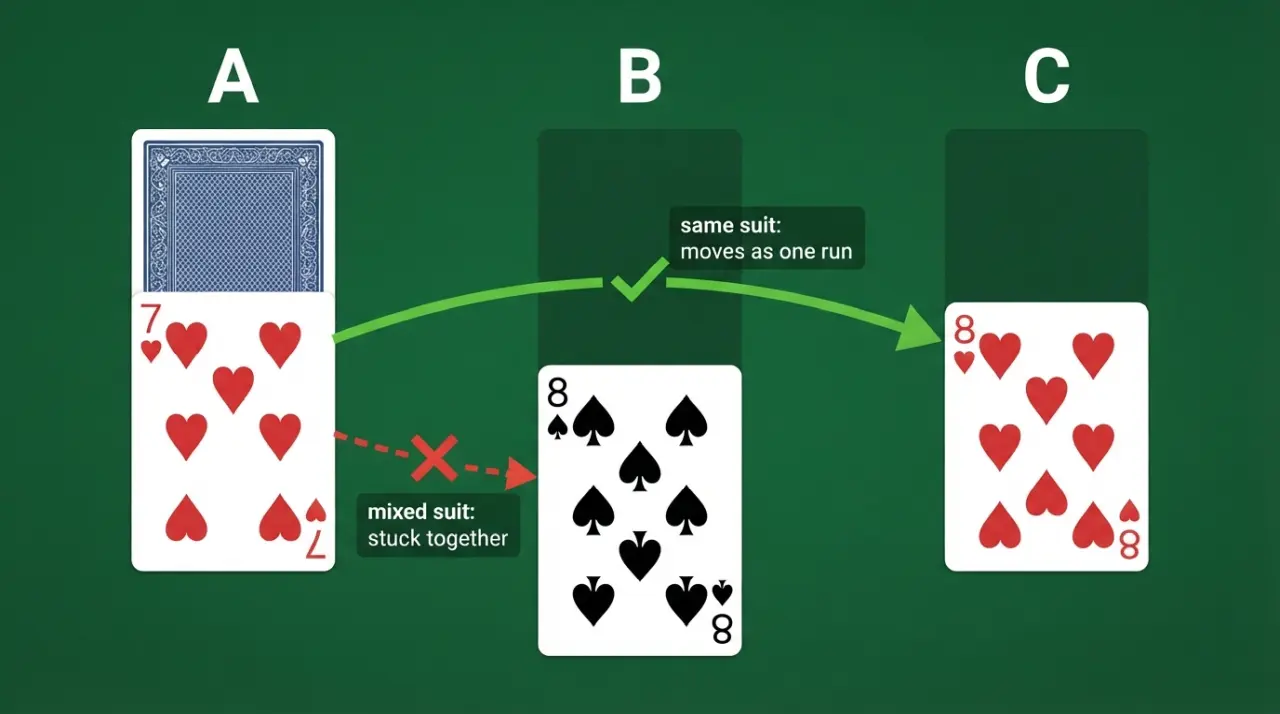
- Column A: ends with the 7 of hearts (face-up), over a face-down card.
- Column B: ends with the 8 of spades.
- Column C: ends with the 8 of hearts.
The tempting move: put the 7 of hearts on the 8 of spades. Both moves are legal and both flip the card in column A, so it looks like a coin toss.
The better move: put it on the 8 of hearts. Now the 8 and 7 form a two-card run in one suit that you can move together. On the 8 of spades the pair is mixed, so you can only move the 7 by itself, and the 8 of spades is stuck under it until you shift the 7 again.
Pro tip: When two moves look equal, pick the one that leaves you more future moves. In Spider that usually means the one that keeps suits together.
FreeCell: Expert Tactics
Every card is face-up from the start in FreeCell, so good freecell strategy is mostly planning. Our FreeCell guide covers the rules.
Plan several moves ahead before you commit
Pick a goal, usually freeing a specific Ace or low card, and work out the full sequence of moves before you make the first one. Check that every card you need to move has somewhere to go. Many lost games end with a card that had no legal home, which was visible from the start.
Keep free cells empty as long as you can
A free cell is a loan, so use one only when you know how you will pay it back. Four filled cells with no plan is usually the end of the game.
Understand the supermove rule
FreeCell moves one card at a time, but apps let you drag a whole sequence by doing the shuffling for you. How many cards you can move depends on your free space:
(empty free cells + 1) × 2empty columns
When you are moving into an empty column, do not count that column.
- 2 empty free cells and 1 empty column, moving onto another column: (2 + 1) × 21 = 6 cards.
- Same layout, moving into the empty column: (2 + 1) × 20 = 3 cards.
- 0 free cells and 0 empty columns: (0 + 1) × 1 = 1 card.
- 4 free cells and no empty columns: (4 + 1) × 1 = 5 cards.
- 1 free cell and 2 empty columns, moving onto another column: (1 + 1) × 22 = 8 cards.
One empty column doubles your capacity, while one free cell adds a single card. That is why empty columns beat free cells.
Release low cards early
Aces and 2s should leave the tableau as soon as they can. They are the foundation of every suit, and the longer they stay buried, the more cards pile on top. Aim to free them in the opening moves, not once the board has become crowded. A low card sitting in a free cell when it could be in the foundation is also wasted space.
Worked example: freeing the Ace of clubs
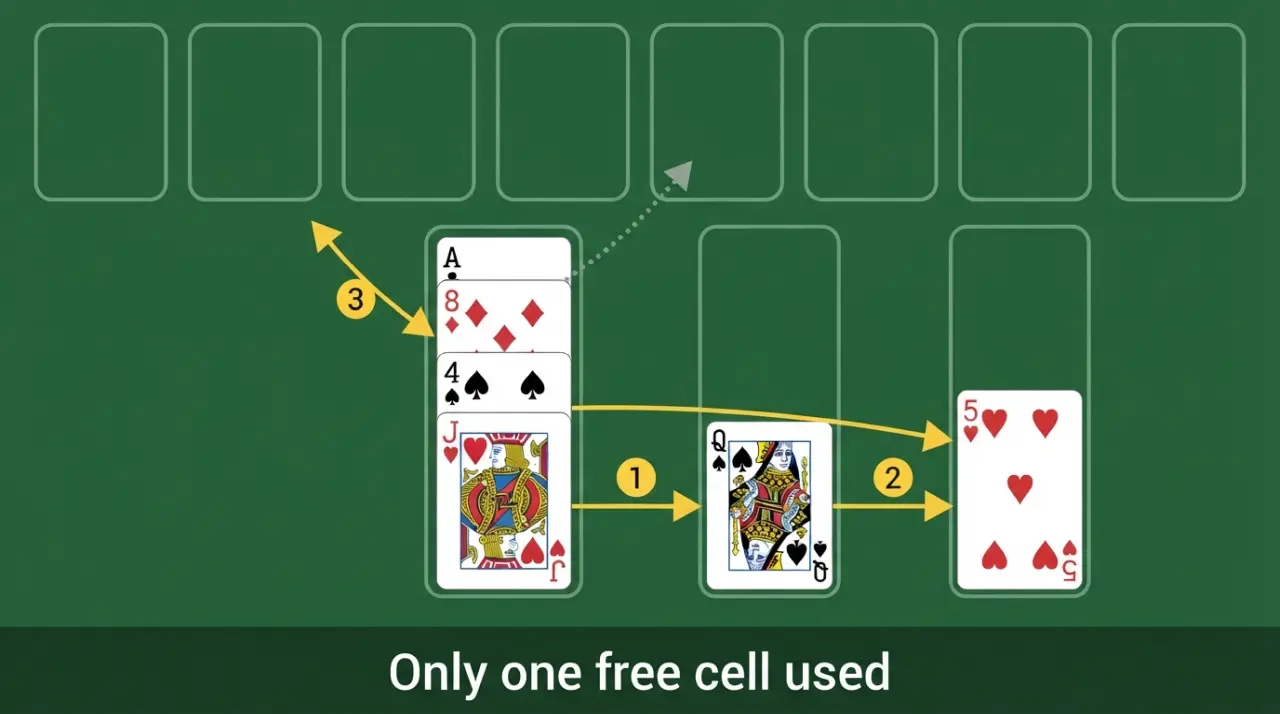
- Column 2 (top to bottom): the Ace of clubs, then the 8 of diamonds, the 4 of spades and the jack of hearts, with the jack as the exposed card.
- Elsewhere, exposed: the queen of spades and the 5 of hearts. No black 9 is showing.
- Free cells: all four empty.
The tempting move: park the jack, the 4 and the 8 in three free cells, then send the Ace to the foundation. It is fast and it works, but you are left with one free cell and a much smaller supermove capacity.
The better move: look for homes first. The jack of hearts goes onto the queen of spades. The 4 of spades goes onto the 5 of hearts. Only the 8 of diamonds has no home, so it takes a single free cell. The Ace is out and you have three cells left.
Pro tip: Before you touch a free cell, say out loud where that card will go next. If you cannot answer, look for a different move.
When to Undo, Restart or Use Hints
These tools are allowed, but they can cost you. How much depends on the app, so check before you start.
- Undo is best used to test an idea. Some apps subtract points for it, some end a bonus, and some do not track it. On this site, in Klondike, each undo costs 2 points and any undo or hint ends the perfect-game bonus. In the Daily Challenge, undo is switched off altogether, as the Daily Challenge guide explains.
- Restart is the right call when the opening was a mistake you can see clearly, or when the deal looks dead. If your app tracks a win streak or stats, a restart may count as a loss, so check first.
- Hints are most useful as a teacher. If you are stuck, take a hint, then work out why it is right. That is worth more than the move itself.
For timed events, decide in advance which tools you will use. Deciding mid-game, when you are frustrated, is how scores get wrecked.
A Weekly Practice Routine for Holiday-Season Events
You do not need hours a day. A few focused sessions beat one long, tired one.
- Monday: Klondike, 3 games. Before each game, spend a minute studying the layout. Pick your first five moves in advance.
- Tuesday: FreeCell, 2 games. Work out how many cards you can move at each step using the supermove formula.
- Wednesday: Spider, 2 games. Count your empty columns after every move. Do not deal until you have run out of useful moves.
- Thursday: review. Replay a game you lost and find the one decision that cost you the most.
- Friday: your weakest variant, 3 games. Play slowly and treat the first ten moves as the whole game.
- Weekend: event practice. Play under the exact conditions of the event: same rules, same tool limits, same time pressure.
Expert Solitaire Strategy FAQ
What is the best expert solitaire strategy?
Plan before you move. In every variant the same habits separate good players from great ones: uncover hidden cards early, protect empty columns, and think through the next few moves before committing to one.
How do I win hard solitaire deals more often?
Slow down at the start of the game, when your choices matter most. Look for the move that opens the most options, not the one that scores the quickest progress. Then review your losses to find the single decision that went wrong.
Is it better to play Spider with one suit or four?
Start with one suit to learn how empty columns and card uncovering work, then move to two suits and later four. The tactics are the same, but with more suits you have to work much harder to keep sequences clean.
How many cards can I move at once in FreeCell?
The usual formula is (empty free cells + 1) multiplied by 2 to the power of the number of empty columns. If you are moving into an empty column, do not count that column. Some apps do the math for you, but it is worth knowing.
Does using undo or hints hurt my score?
It depends on the app. Some apps subtract points, some end bonuses, and some leave scoring alone. Check the rules of any event before you start, and decide ahead of time whether you will use these tools.