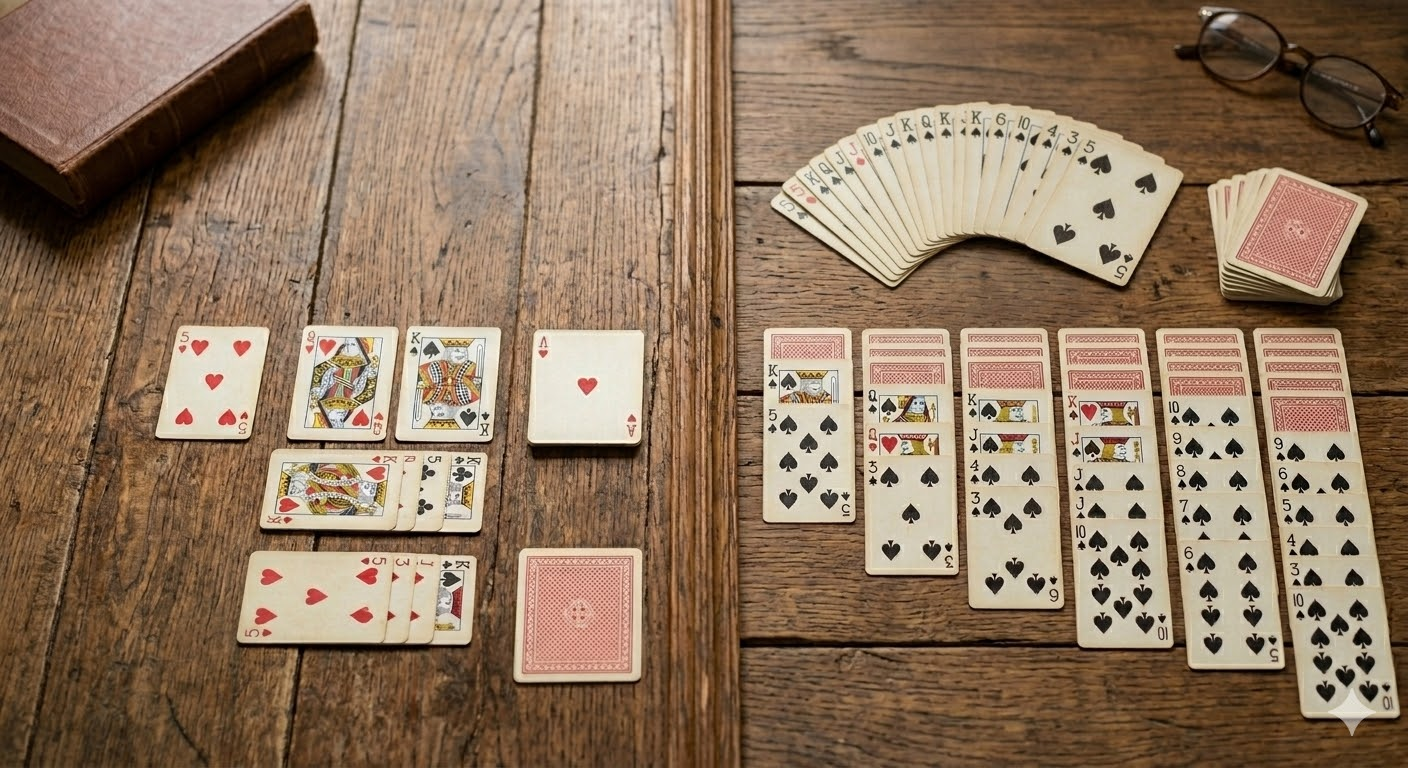
Klondike vs Spider Solitaire: key differences and which to play
The key difference between Klondike and Spider is the movement rule. Klondike lets you move cards onto any card of the opposite color and lower rank. Spider requires that when you move multiple cards at once, they must all be the same suit. That single constraint changes the entire game.
Beyond that rule, Spider uses two 52-card decks across 10 columns instead of one deck across 7, and the win condition is different: instead of building 4 foundations by suit from Ace to King, you're assembling 8 complete same-suit sequences of 13 cards that automatically clear off the board when completed.
What's the difference between Klondike and Spider Solitaire?
Klondike uses one 52-card deck. Spider uses two — 104 cards across 10 columns, with more still waiting in the stock to be dealt in rounds. That's why Spider's board looks so much more crowded even before you've played a move.
The extra columns in Spider mean more face-down cards to work through early on, and more places for useful cards to get buried. In Klondike's 7-column setup, 21 of the 28 initial tableau cards are face-down. In Spider's 10-column layout, 44 of the 54 are. You're starting with a lot less information in Spider, and the board takes longer to open up.
The movement rule is where the games genuinely split. In Klondike, you can move a sequence of cards as long as the bottom card fits onto the destination — the sequence doesn't need to be the same suit. In Spider, a multi-card sequence can only move if the entire thing is one suit. Mixed-suit sequences are stuck: you can shift cards off the top one at a time, but you can't move the group. That one rule is responsible for most of Spider's difficulty.
The win conditions also differ. Klondike is done when all 52 cards are in 4 foundation piles, built by suit from Ace to King. Spider is done when you've assembled all 8 same-suit sequences of 13 cards and they've cleared from the board. And the stock works differently too: in Klondike you draw one or three cards at a time as needed; in Spider you deal an entire round all at once, one card face-up onto each of the 10 columns. There are 5 rounds available, and each one lands whether you're ready for it or not.
Klondike Solitaire overview
Klondike is what most people mean when they say "Solitaire." It shipped as the default Windows game in 1990, it's still the most-played version on every mobile app store, and it's the game almost everyone learned first. One deck, 7 columns, 4 foundations, a stock pile you draw through one or three cards at a time.
The core tension is this: to expose face-down cards you have to move face-up cards around, but those same face-up cards are what you need to build foundations. Do too much of one and you stall on the other. Getting that balance right is most of what separates a winning game from a stuck one.
Skilled players win 55–65% of Klondike Draw 1 games. Beginners tend to see 20–35%. That gap is mostly decision-making, not luck. The same shuffled deck plays out very differently depending on the choices you make.
If you're new to Solitaire, Klondike is where to start. The rules take a few minutes to learn, games finish quickly, and you get clear feedback on what went wrong. Play Klondike at Solitaire Mastery.
Spider Solitaire overview
Spider comes in three variants, and honestly they feel like different games more than different difficulty settings.
Spider 1-suit uses only one suit across all 104 cards, typically spades. Because everything is the same suit, the same-suit movement rule barely applies — you can always move multi-card sequences freely. Win rate approaches 100% with competent play. It's a reasonable way to get used to Spider's layout and the round-dealing mechanic without the full weight of the suit constraint.
Spider 2-suit is where the game actually starts. Now you have two suits, and every sequence-building decision involves a tradeoff: do you extend this run in hearts, or does doing so wreck the spades sequence you've been building for the last eight moves? Good players win 50–60% of 2-suit games. That's where most experienced Spider players spend their time — hard enough to stay interesting, not so punishing that it stops being fun.
Spider 4-suit is the one people are talking about when they say Spider is a hard game. All four suits in play, same-suit sequences required for any multi-card move, and 104 cards to track. Expert players win 10–15% of 4-suit games. Building a complete same-suit sequence often requires 10+ moves of careful setup, and one bad round deal can unravel an hour of work.
Play Spider Solitaire at Solitaire Mastery, including all three suit variants.
Which is harder?
Spider 1-suit is honestly comparable to Klondike in difficulty — maybe slightly easier, given its near-100% win rate with competent play. But 2-suit Spider is a different game entirely, and 4-suit is in another category.
Klondike's difficulty comes from hidden information. The face-down cards and the stock pile mean you're constantly making decisions without knowing what's coming. You might play perfectly and still lose because the cards were stacked against you. About 21% of Klondike deals are mathematically unwinnable regardless of play.
Spider's difficulty comes from the movement constraint. In 4-suit Spider, all the cards are eventually visible — but being able to see a card you need and having no legal path to use it is its own kind of frustration. The game is hard not because of what you don't know but because of what you can't do with what you do know.
The skill ceiling in Spider 4-suit is probably the highest of any mainstream Solitaire variant. Top-level play involves tracking 15 or more card dependencies simultaneously. Klondike's ceiling is lower partly because luck has a bigger role — there's a hard limit on what skill can do with an unwinnable deal.
Which should you play?
If you're new to card games or haven't touched Solitaire in years, start with Klondike Draw 1. The rules are intuitive, games take 5–10 minutes, and the instincts you build — expose face-down cards, think before moving, watch the foundations — transfer directly to every other variant.
Once you're winning Klondike consistently, Spider 1-suit is the right next step. Same general idea, but the 10-column layout and the round dealing change how you have to plan. It won't take long before 1-suit starts feeling easy, which is when you move to 2-suit.
Spider 2-suit is where I'd tell most people to stay for a while. It's genuinely hard, the games are long enough to feel meaningful, and the strategic depth keeps it from getting stale. 4-suit is there when you want to be humbled — and if you're winning 50%+ of 2-suit games, you'll be humbled.
One more worth mentioning: FreeCell. If what draws you to Klondike is the puzzle-solving and the luck element annoys you, FreeCell is almost entirely skill. Nearly every deal is solvable. When you lose, it's because you missed something, not because the cards were cruel.
Can you play both?
Yes, and the habits carry over. Scanning the full board before moving, asking what a move unlocks rather than just whether it's legal, knowing when a game has gone sideways — that thinking applies to both games. Playing one makes you better at the other.
A lot of players alternate depending on how much they want to think. Klondike Draw 1 can be almost meditative when you're in a groove. Spider 4-suit is the opposite — it demands full attention from the first move and doesn't let up. Both have their place.
Both are available at Solitaire Mastery: Klondike Solitaire and Spider Solitaire.