Is every Solitaire game winnable? The truth about unwinnable deals
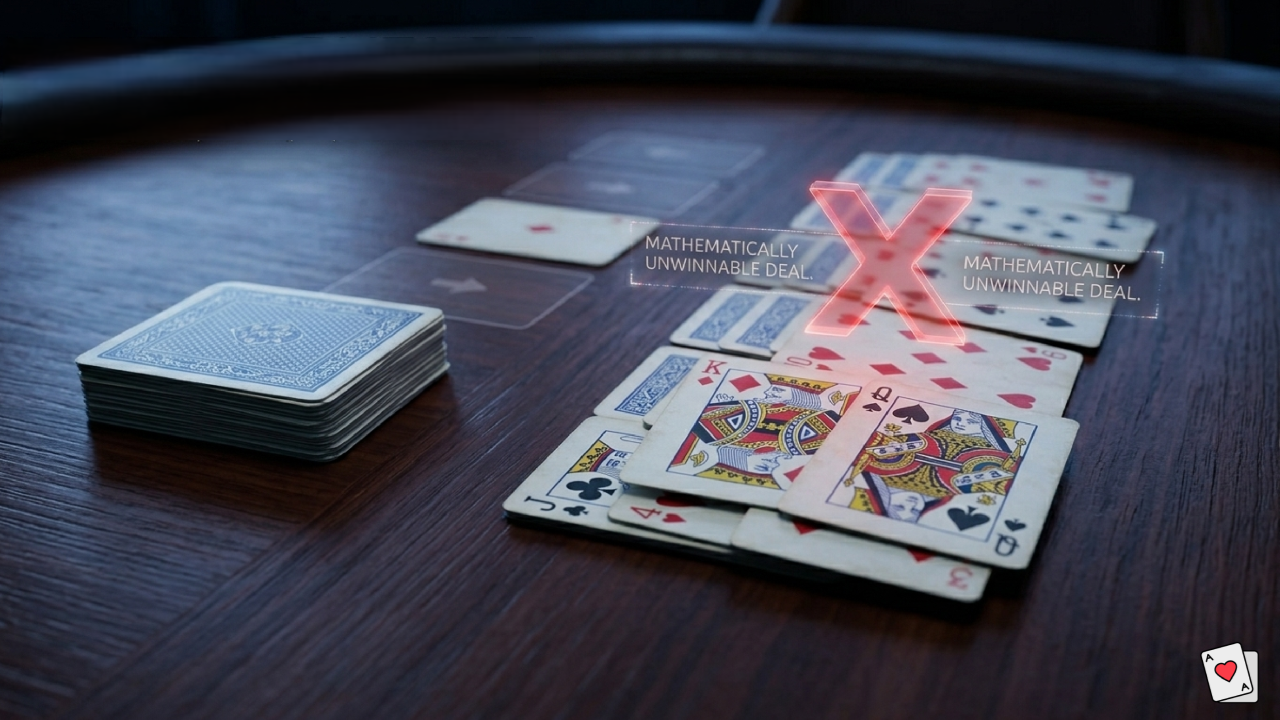
No. About 21% of Klondike Solitaire deals are mathematically unwinnable — no amount of skill or strategy can complete them. If you've ever been convinced you were one move away from a breakthrough and then cycled through the stock ten more times with nothing to show for it, there's a reasonable chance the game was never going to let you win.
You're not just playing against your own skill. You're also playing against a real probability that the cards are arranged in a way that defeats everyone, including a perfect player with full knowledge of the deck.
Can you win every game of Solitaire?
No, you can't. Computational analysis has established that roughly 79% of Klondike Draw 1 deals are theoretically solvable. The remaining ~21% are not — no sequence of legal moves leads to all 52 cards on the foundations, so those games are lost before you play your first card.
There are two types of unwinnable situations. The first is a deal that no one can win: a computer with perfect information and infinite time couldn't solve it either. The second is a deal that could have been won but wasn't, because a bad move early on closed off the only working path.
From the inside, both feel identical. You can't tell whether you hit a wall because the deal was bad or because one specific move an hour ago was wrong. That's part of what makes Klondike genuinely hard to reason about.
What makes a Solitaire game unwinnable?
The root cause is almost always dependency conflicts. Klondike requires cards to move in an order dictated by rank, suit, and color. When the initial shuffle puts cards in positions where their required moves block each other, the game locks up permanently — and there's no way out.
Circular dependencies are the most common culprit. Card A needs to move before card B can be accessed, but moving card A first requires card B to already be somewhere else. Both moves depend on the other happening first. The game just sits there, and no number of stock cycles resolves it.
Buried Aces create a different kind of problem. Foundations must start with Aces. If all four are deep under face-down cards with no path to expose them, you can't start the foundations. Without foundation progress there's nowhere for cards to go, the tableau never opens up, and the game is stuck before it really begins.
Stock exhaustion with no viable moves is the third pattern. This happens when you've cycled through the full stock multiple times and every card in the waste pile is blocked in the tableau. No foundation progress, no tableau rearrangement possible. The game has run out of moves, but not because you made a mistake — the deal put you there.
How to tell if your game is unwinnable
There's no perfect signal while you're playing, but a few signs point strongly toward an unwinnable deal:
- Multiple Aces are buried under long chains of face-down cards with no sequence available to start exposing them
- Same-suit cards are blocking each other — for example, the 3 of hearts is sitting on top of a pile that contains the 2 of hearts somewhere below it
- You've recycled the stock 3 or more times and made no progress on either foundations or tableau face-down card exposure
- The hint system shows no suggestions — if the game's logic can't find a useful move, that's meaningful information
- Every tableau move you can see would worsen your position rather than improve it
None of these are definitive proof. A good player can sometimes find a path out of what looks like a stuck position. But after 3 stock cycles with no progress, the probability of a solution is low enough that starting fresh is usually the better use of time.
The harder question is when to keep trying vs. when to accept the deal was bad. My rough heuristic: if the hint system shows nothing and you've exhausted the stock twice, give yourself one more careful pass. If nothing breaks open, start a new game.
Winnability by Solitaire variant
The 21% figure is specific to Klondike. Other variants land in very different places.
Spider Solitaire 1-suit is close to 100% winnable with competent play. With only one suit in play, the same-suit sequence requirement isn't constraining, and the game rarely produces genuine dead ends.
Spider 4-suit is near the opposite extreme. Expert players win 10–15% of deals. The four-suit same-suit sequence requirement creates brutal dependency chains, and a bad initial deal is very difficult to recover from regardless of skill. You can play Spider at Solitaire Mastery's Spider page.
FreeCell is almost entirely winnable — approximately 99.999% of standard deals have solutions. The four free cells and full card visibility from the start give players enough flexibility to work around almost any initial arrangement. See the section below.
Klondike Draw 3 is theoretically 82% winnable but practically much harder. The stock's 3-at-a-time structure means many theoretically accessible cards are practically buried under timing constraints. Skilled players win 40–50% in Draw 3, compared to 55–65% in Draw 1. You can practice both modes on the Klondike Solitaire page.
The mathematics of unwinnable Solitaire
The initial card placement creates a dependency graph. Each card has conditions that must be met before it can move: the card above it must already be gone, the destination must have the right card waiting, and so on.
Winning requires finding an ordering of all card moves that satisfies every constraint at once. In graph theory terms, you're looking for a topological sort of the dependency graph.
Some graphs have no valid topological sort. If there's a cycle — A depends on B, B depends on C, C depends on A — then no ordering works and the cycle can't be broken. That's why some Klondike deals are provably unwinnable rather than just very hard.
Klondike has more hidden information than most solitaire variants, which is exactly why its unwinnable rate sits around 21%. FreeCell has no hidden information at all. You can trace the dependencies from move one, which is why almost every FreeCell deal has a solution.
FreeCell: a special case
FreeCell behaves so differently from Klondike it deserves its own section. All cards are face-up from the first move. The four free cells let you temporarily park cards that are in the way. Together these features mean the dependency graph is almost always navigable.
Researchers analyzed all 32,000 deals in the classic Windows FreeCell set computationally and found exactly one that cannot be won: Deal #11982. Not "very hard," not "rarely solved." Provably, exhaustively impossible.
Deal #11982 wasn't discovered by a frustrated player. It was found through automated exhaustive search — software that tried every legal sequence of moves and confirmed that none of them produced a solution. That's a different kind of certainty than "I couldn't figure it out."
For FreeCell players: if you're stuck, you're almost certainly missing a move. Unlike Klondike, giving up on a FreeCell game because it "seems unwinnable" is almost always wrong.
Should you give up on a hard game?
Sometimes yes, and that's not a failure. In Klondike specifically, spending 20 minutes on a game that was unwinnable from the first card is just lost time. Recognizing the signals and starting fresh is a legitimate strategy.
Before quitting, try these:
- Play Easy mode if you want fewer unwinnable deals. The shuffle algorithm is designed to produce more solvable arrangements.
- Use hints before quitting — the hint system sometimes surfaces moves that aren't obvious. If hints come back empty, that's useful information.
- Use unlimited undo to explore different paths. One of the best things about digital Solitaire is that you don't have to commit to a sequence. Back up and try the other branch.
- Check the stock count. If you've seen the full stock twice and made no foundation progress, the odds are against you. Three times with no progress is a strong signal to move on.
The game tracks your win rate, but your win rate on games played to completion is more informative than your overall percentage. If you start fresh whenever a deal looks bad without exhausting your options first, you'll inflate the number without actually improving. That said, not every stuck-looking game is worth 30 more minutes. Two stock cycles with no progress is a reasonable place to draw the line.