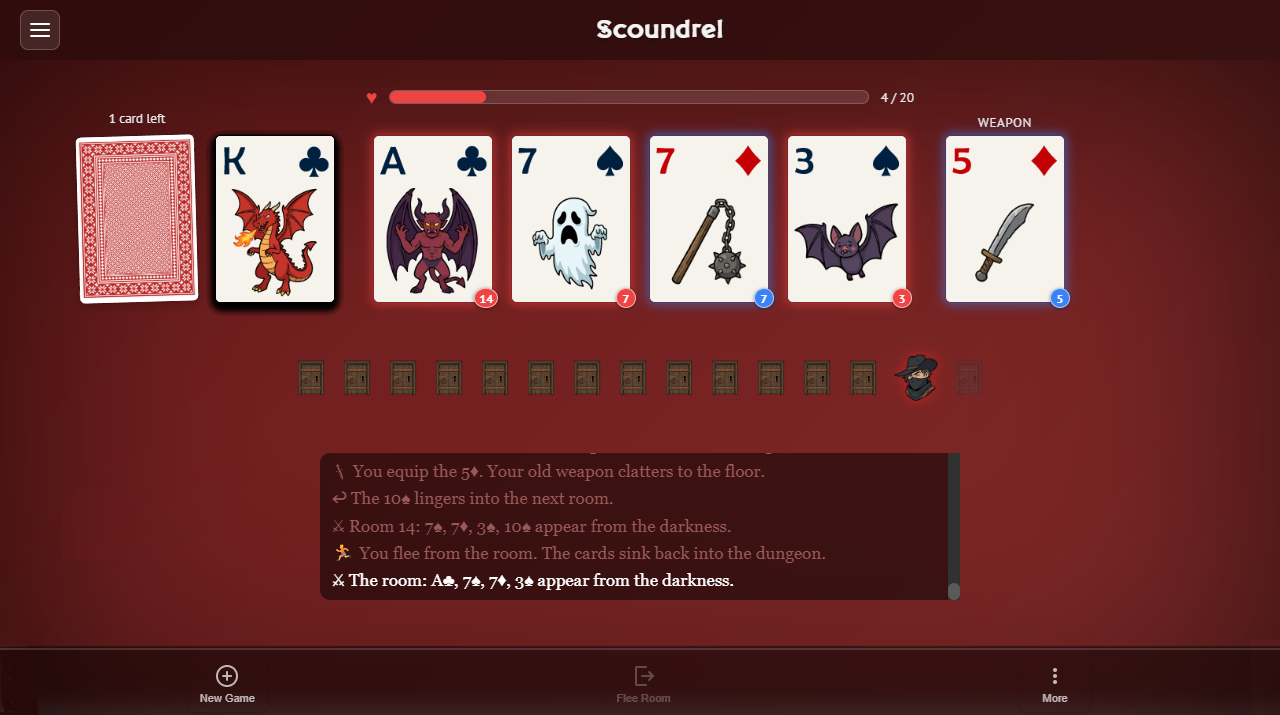
How to Play Scoundrel: Rules, Strategy & Tips for the Dungeon Card Game
Scoundrel is a solo dungeon-crawler that plays out in about ten minutes with a standard deck of cards. You fight through 15 rooms, pick up weapons, drink potions when your health gets low, and try not to die. Most attempts end badly. It was designed by Zach Gage and Kurt Bieg as a print-and-play — rules on one page, nothing else required.
What makes it interesting is the weapon mechanic. Every time your weapon kills a monster, it gets a little less capable. Fight something too strong early, and your weapon is useless for the rest of the run. That single rule is where most games are won or lost.
The deck
You don't use a full 52-card deck. Remove the red face cards (Jack, Queen, King of hearts and diamonds) and the red Aces. That leaves 44 cards:
- All 13 clubs and all 13 spades — monsters
- Diamonds 2 through 10 — weapons (9 cards)
- Hearts 2 through 10 — potions (9 cards)
Card values follow the rank: 2 through 10 at face value, Jack = 11, Queen = 12, King = 13, Ace = 14. Monsters deal damage equal to their rank. Weapons reduce damage by their rank. Potions heal by their rank, up to the 20 HP cap.
There are no monsters higher than 14 and no potions or weapons above 10. That gap matters — the strongest monsters in the deck can't be absorbed by any weapon alone. You'll take some damage no matter what.
How a room works
Each turn, four cards are dealt face-up. That's your room. You have to deal with at least three of them. The one you leave carries into the next room — it'll be there waiting when the next three cards are dealt.
There's no skip for bad rooms. You can flee (more on that below), but you can't just pick the three easiest cards and move on without consequence. Whatever you leave behind, you'll have to face next turn.
The game runs for 15 rooms total. First room gets four fresh cards; every room after refills three slots around the one card you carried over.
Combat
Barehanded
Click a monster with no weapon equipped and you take its full rank as damage. A King hits for 13. An Ace hits for 14. There's no way to reduce barehanded damage — it's the full number, every time.
With a weapon
Equip a diamond card first. Then when you fight a monster, you take the difference between the monster's value and your weapon's value, minimum zero. A 6-diamond weapon against an 8-monster means 2 damage. Against a 4-monster, it's zero — the weapon absorbs it completely.
The trade-off is the restriction rule. Once your weapon kills a monster, it can only be used against monsters with a lower value than the last one it killed. Kill an 8, and your weapon is done with anything ranked 9 or above. Kill a 5, and it can't handle anything 6 or higher.
This is the mechanic the whole game is built around. A weapon that kills a high-value monster early is basically a liability. A weapon that kills progressively weaker things stays useful longer — but you have to take more damage getting there.
Equipping a weapon
When a diamond card appears in your room, clicking it equips it. If you already have a weapon, you'll be asked to confirm — equipping a new one discards the old weapon along with every monster stacked on it. Those trophies go to the discard pile and the restriction resets.
You don't have to equip every weapon you see. Sometimes it's better to fight barehanded and save a weaker monster kill for a weapon you've already invested in. Sometimes a fresh weapon in the middle of a rough run is worth the reset. That's a judgment call every time.
Potions
Hearts heal you by their rank, capped at 20. A 7 of hearts restores 7 HP. A 10 of hearts at full health does nothing useful — the cap is hard.
One important rule: only the first potion in a room heals you. If your room has two hearts, the second one is wasted no matter how low your health is. Plan around that. Seeing two potions in one room isn't twice the luck — it's one potion and one dead card slot.
Fleeing
Before you play any card from a room, you can flee. All four cards go face-down to the bottom of the dungeon and three new ones are dealt. The room you fled doesn't count toward your progress — you'll see those cards again later.
Two restrictions: you can't flee two rooms in a row, and you can't flee once you've already played a card. So the decision has to happen before you commit to anything.
Fleeing is most useful when a room has a high monster you can't safely fight right now and nothing to offset it. It's not a solution — those cards come back — but sometimes buying a room is worth it.
Win and loss conditions
Clear all 44 cards without your HP hitting zero and you win. Your score is your remaining HP.
There's one bonus case: if the very last card you play is a potion that would have healed you past 20, your score is 20 plus that potion's rank. Ending on a 10-of-hearts at 15 HP gives you a score of 30 instead of 20. It's a small reward for a clean finish.
If your HP hits zero, the game ends immediately. Your loss score is your current HP (negative, if you took more damage than you had) minus the total value of every monster still left in the dungeon and the room. It's usually a painful number.
Strategy
Equip something early. Going multiple rooms without a weapon means full damage on every fight. Even a 2-of-diamonds reduces the sting of low-value monsters. Get something equipped before the tough clubs and spades show up.
Don't waste your first kill on a weak monster. A fresh weapon has no restriction. The moment you use it, the restriction locks in at whatever you killed. If your first weapon kill is a 3, you've permanently limited it to monsters valued 3 or below — which is almost useless. Save that first kill for something meaningful.
Potions near full health are mostly wasted. The 20 HP cap is strict. Drinking a 9-of-hearts at 16 HP heals 4, not 9. If you're healthy, leaving a potion as the carried card into the next room isn't ideal, but it's better than drinking it at near-full health and wasting most of it.
Think about what you carry over. The card you leave behind is the first thing you'll see next room. Carrying a King of Spades (value 13) into a room where you have no weapon is a bad time. If you have a choice, carry over something you can handle or something useful.
Flee selectively. You only get to flee every other room at most, and those cards come back. Fleeing a room with one scary monster just delays the problem. It's most defensible when the room has two or three monsters you genuinely can't handle right now — not just one bad one you'd rather avoid.
Track what's left. The deck has 26 monsters, 9 weapons, and 9 potions. Once you know what's been played, you have some sense of what's likely coming. If all the low-value diamonds are gone, a new weapon won't help much. If most of the high monsters are in the discard pile, you're in better shape than it feels.
Frequently asked questions
How many cards are in the Scoundrel dungeon?
44. A standard deck with the red face cards and red Aces removed. That leaves 26 monsters (all clubs and spades), 9 weapons (diamonds 2-10), and 9 potions (hearts 2-10).
How does the weapon restriction work?
When your weapon kills a monster, it can only fight monsters with a lower value from that point on. Kill an 8, and anything ranked 9 or above has to be fought barehanded. The restriction resets when you equip a new weapon — but equipping a new weapon discards the old one and its trophies.
Can you carry potions between rooms?
There's no inventory. Potions only appear in rooms, and you have to deal with them (drink or ignore) as part of playing through the room. The one card you carry over can be a potion, but you'll have to play it in the next room regardless.
What happens if you flee?
All four room cards go face-down to the bottom of the dungeon. Three new cards are dealt. The room progress doesn't advance. You can't flee again the next room, and you can't flee if you've already played a card from the current room.
How do you score in Scoundrel?
Win score is your remaining HP — higher is better. Loss score is current HP (possibly negative) minus the total value of monsters still in the dungeon and room. There's a bonus for winning on a potion overflow: score equals 20 plus the potion's rank.
Who designed Scoundrel?
Zach Gage and Kurt Bieg, originally as a print-and-play game. The rules fit on a single page and the whole thing plays with cards you already own.