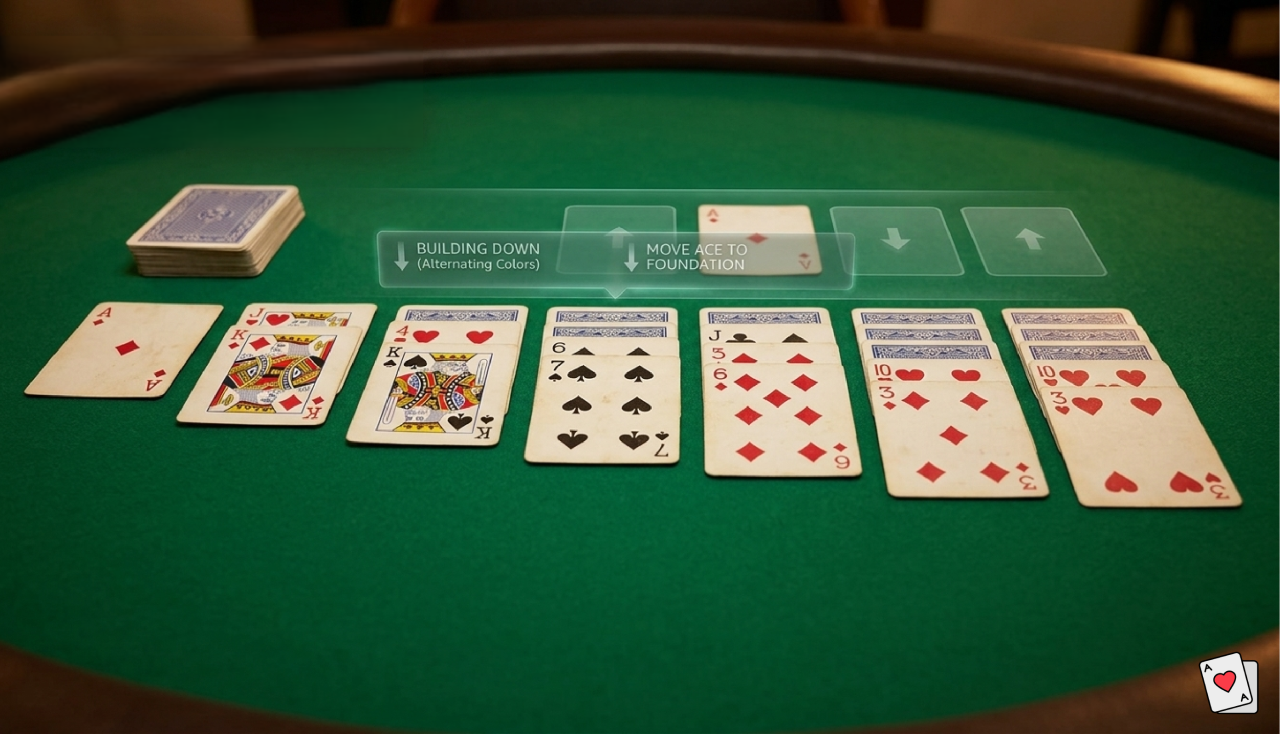
How to play Solitaire: complete rules & strategy guide
Solitaire (also called Klondike Solitaire) is a single-player card game played with a standard 52-card deck. The goal is to move all 52 cards to four foundation piles, each sorted by suit from Ace to King. A game typically takes 5–15 minutes.
Most people over 35 first played Solitaire on Windows — which means a game invented in the 1800s became a global phenomenon because Microsoft needed something to teach people how to use a mouse. It worked. And now here we are, decades later, still playing it. This guide covers everything: how to set up the game, the rules, strategy, and the main variants worth trying.
You can play Solitaire free right here if you want to follow along while you read.
What is Solitaire?
"Solitaire" is technically a category of card games — any game you play alone qualifies. But in practice, when someone says they're playing Solitaire, they mean Klondike. It's the version that shipped with Windows 3.0 in 1990, the one that came pre-installed on every PC for the next two decades, and the one that most people picture when they hear the word.
The game itself predates computers by a long time. Klondike got its name from the Klondike Gold Rush of the 1890s, when prospectors would pass the time during the long northern winters. The exact origins are murky — card game historians debate who invented it and when — but the core mechanics have barely changed in over a century.
What makes Klondike stick around is the balance between luck and skill. The initial deal is random, and some deals are genuinely unwinnable. But within the space of a winnable deal, your decisions matter a lot. You're constantly making small choices — which card to move, whether to draw from the stock now or exhaust the tableau first, whether to send a card to the foundation or keep it in play. Most of those choices feel low-stakes until you realize three moves later that you've locked yourself into a dead end.
What you need to play
To play Solitaire with a physical deck: one standard 52-card deck, a flat surface, and a few minutes. No opponents. No special equipment. Any age.
Or just play free online and skip the shuffling entirely. The digital version handles dealing, validates your moves automatically, and lets you undo mistakes — which is genuinely useful when you're still learning.
How to set up Solitaire
The game layout
Before you deal a single card, understand what you're looking at. A standard Solitaire game has four distinct areas:
- Tableau — The seven columns in the main playing area. Most of the game happens here. You'll be building sequences, uncovering face-down cards, and maneuvering stacks around the tableau for most of the game.
- Foundation — Four piles in the upper right (or upper portion of the board). This is where you're building toward victory. Each pile is for one suit, starting with the Ace and building up to the King.
- Stock pile — The face-down deck on the upper left. You draw from here when you run out of useful moves in the tableau.
- Waste pile — Cards you've drawn from the stock but can't play yet sit here, face-up. Only the top card is available to play.
Dealing the cards
The tableau is dealt in a specific staircase pattern. Here's exactly how it works:
- Column 1: 1 card, face-up
- Column 2: 1 card face-down, then 1 card face-up on top
- Column 3: 2 cards face-down, then 1 card face-up on top
- Column 4: 3 cards face-down, then 1 card face-up on top
- Column 5: 4 cards face-down, then 1 card face-up on top
- Column 6: 5 cards face-down, then 1 card face-up on top
- Column 7: 6 cards face-down, then 1 card face-up on top
That's 28 cards total in the tableau (1+2+3+4+5+6+7). The remaining 24 cards go face-down into the stock pile. Each column shows exactly one face-up card at the start. Everything else is hidden.
Quick reference: After dealing, you'll see 7 face-up cards across the tableau (one per column), 21 face-down cards buried under them, and a stock pile of 24 face-down cards. That's 52 cards total.
The rules of Solitaire
Foundation pile rules
Foundations are where you win the game. Each of the four foundations is dedicated to one suit (hearts, diamonds, clubs, spades). To start a foundation pile, you need an Ace of that suit. Then you build upward, in order:
Ace → 2 → 3 → 4 → 5 → 6 → 7 → 8 → 9 → 10 → Jack → Queen → King
Every card must match the suit of that pile. You can't put a 5 of hearts on a 4 of diamonds. Once a card is on the foundation, most versions let you move it back to the tableau if you need it — but you rarely want to. It slows you down and should be a last resort.
Tableau rules
In the tableau, you build downward in alternating colors:
- A red card can only go on a black card one rank higher
- A black card can only go on a red card one rank higher
So a black 7 goes on a red 8. A red Queen goes on a black King. A red 3 goes on a black 4. Color and rank both have to work simultaneously — you can't have two reds in a row, and you can't skip ranks.
You can move sequences of cards together. If you have a red 6 sitting on a black 7, you can pick up both and move them onto a red 8 in another column. The whole sequence moves as a unit.
Empty columns — when you clear all the cards out of a column — can only be filled by a King (or a sequence that starts with a King). You cannot put any other card into an empty column. This matters more than it sounds: empty columns are the most flexible resource on the board, and the decision of what King to put there is often significant.
Stock and waste pile
Click or tap the stock pile to draw cards. In Draw 1 mode, you flip one card at a time to the waste pile. In Draw 3 mode, you flip three cards, but only the top one is playable.
The top card of the waste pile can be played to the tableau or foundation at any time. When the stock is empty, flip the waste pile over to form a new stock and draw through it again. Most versions allow unlimited redeals.
Winning the game
Move all 52 cards to the four foundation piles, each complete from Ace to King. When all four foundations are full, you win. Most digital versions will trigger the win automatically and start a card-falling celebration once the last card lands.
How to play Solitaire step by step
Here's a walk-through of the opening moves in a typical game. The specific cards will be different every time, but the thought process behind each move is what you want to internalize.
First, scan the seven face-up tableau cards for any Aces. If you see one, move it to the foundation immediately. An Ace has no use in the tableau — it can't go on anything there — and you need it on the foundation to start building. This is always the right call.
Next, look for face-down cards you can uncover. Every face-down card in the tableau is a card you can't plan around. Find the move that flips a hidden card. Say column 3 shows a red 7 and column 5 shows a black 8 — move the red 7 onto the black 8. That uncovers whatever is hiding in column 3, which might be exactly what you need, or might kick off another chain of moves.
Once you have an Ace on a foundation, you're watching for the matching 2. When it appears in the tableau or waste pile, send it up. Low cards — Aces through 4s, roughly — are almost always safe to move to the foundation right away. They're rarely needed as tableau targets.
If you've checked every face-up card in the tableau and nothing is moving, draw from the stock. The top card of the waste pile is now available. If it plays somewhere, great. If not, draw again.
If you clear a column entirely, resist the urge to immediately fill it with the nearest King. Only a King can go there, so think about which King is most useful: the one that starts a long sequence, or the one that's sitting on top of a card you urgently need.
You'll often cycle through the entire stock without winning. Flip the waste pile back and draw through again. The tableau will look different by then, and cards that had nowhere to go earlier may fit somewhere now.
Solitaire strategy: how to win more often
The rules take about five minutes to learn. Winning consistently — especially in Draw 3 — is another matter. These are the principles that separate players who win occasionally from those who win most of the time.
1. Prioritize exposing face-down cards over almost everything else
Every face-down card in the tableau is a card you can't plan around. When you're choosing between a move that flips a hidden card and one that doesn't, take the first option unless you have a specific reason not to. Uncovering a new card is almost always worth more than moving a card you can already see.
Column 7 starts with six cards face-down. Column 6 has five. Getting into those deep columns early pays off far more than tinkering around column 2.
2. Treat empty columns as a resource, not a nuisance
An empty column is incredibly powerful. It lets you temporarily park a card or sequence while you rearrange things elsewhere — like a free extra hand. Experienced players go out of their way to create empty columns and use them strategically. Don't rush to fill an empty column with the first King you see. Wait until you have a King that unlocks something, or until you need the space urgently.
3. Keep your foundations roughly balanced
It's tempting to race one suit up the foundation the moment you get the chance. Resist this. If hearts is at 8 and the other suits are at 2, you've likely buried cards from the lower suits that need to come out before the game ends. A good rule of thumb: don't let any foundation get more than 3-4 ranks ahead of the others unless you have no choice.
The reason is subtle. Low-to-mid cards (5s, 6s, 7s) serve double duty — they can go to the foundation eventually, but they're also needed in the tableau as building targets. If you've already moved them all to the foundation and you need a 6 as a staging card, you're stuck.
4. Think before drawing from the stock
The stock pile isn't a panic button. Before you draw, check: have you looked at every valid tableau move? Drawing from the stock doesn't reset anything — you still have to come back to those tableau moves later. Exhaust your options in the visible layout before touching the stock.
Also pay attention to what's in the waste pile. In Draw 3 mode especially, the card you need might be buried two cards down. Knowing this changes whether you want to play the top waste card now or hold off.
5. Think one move ahead, not zero
Not all valid moves are equally good. The best ones create chain reactions — you move one card, which flips a hidden card, which lets you build a sequence in a different column. Before moving anything, ask yourself: what does this make possible? A move that leads to two more moves beats one that leads to nothing, even if both are technically legal.
6. Choose Draw 1 vs Draw 3 based on your skill level
Draw 1 is more forgiving. You see every card in the stock one at a time, and you have more control over what becomes available. Draw 3 is harder because most of what's in the stock is inaccessible to you at any given moment — two out of every three cards are buried under the one you can see. See the full comparison in the Draw 1 vs Draw 3 section below.
7. Use undo
In digital Solitaire, undo exists for a reason. Using it isn't cheating — it's how you learn. When a move leads to a dead end, undo it, figure out what went wrong, and try something else. Over enough games, you start recognizing those dead ends before you walk into them. That's the whole learning loop. Play here and use the undo button freely.
For deeper strategy coverage, see our full Klondike Solitaire strategy guide.
Draw 1 vs Draw 3: which should you play?
The draw mode changes the game more than any other setting. In Draw 1, you flip one card at a time from the stock. Whatever comes up is immediately available to play. You cycle through the entire deck one card at a time, so you'll eventually see everything — and decide on each card individually.
In Draw 3, you flip three cards at once, but only the top card of those three is playable. The two below it are locked until the top card is moved. This means that at any given moment, most of your stock is inaccessible. Playing that top card might reveal something useful underneath, or it might reveal another card you can't use. You're constantly making probabilistic guesses about what's buried.
The win rate difference is significant. In Draw 1, roughly 79% of deals are theoretically winnable, and a competent player wins 55-65% of games in practice. In Draw 3, the theoretical winnability is similar, but practical win rates for most players drop to 15-25%. The same skills apply in both modes, but Draw 3 punishes mistakes much more harshly and offers far fewer ways out when you make one.
Start with Draw 1. Once you're consistently winning more than half your games and the strategy feels natural, switch to Draw 3. The habits you build in Draw 1 — uncovering face-down cards, managing empty columns, balancing foundations — transfer directly. Draw 3 just adds the layer of stock management complexity on top. Full comparison in our Draw 1 vs Draw 3 guide.
Solitaire scoring: how points work
Classic Windows-style Solitaire scoring awards points for specific moves:
- 10 points for moving a card to the foundation
- 5 points for moving a waste pile card to the tableau
- 5 points for flipping a face-down tableau card
- -2 points per 10 seconds elapsed (time penalty in timed mode)
- -15 points for recycling the stock (in some rule sets)
Most online Solitaire games use variations of this system, often adding bonuses for winning quickly or completing the game without undos. The leaderboard here uses a combination of time, move efficiency, and completion bonuses. For the full breakdown of how scores are calculated and what counts as a good score, see our Solitaire scoring guide.
Solitaire variants: other games to try
Spider Solitaire
Spider uses two full decks (104 cards) spread across 10 tableau columns. Your goal is to build complete suit sequences from King down to Ace, which then get removed from the board. There are three difficulty modes: 1 suit (all spades), 2 suits, or 4 suits. The 1-suit version is manageable for beginners; the 4-suit version is genuinely hard.
The main difference from Klondike: in Spider, you can build sequences in any color, but only a complete same-suit sequence from King to Ace actually gets removed from the board. That distinction matters a lot once you're mid-game and have a tangle of mixed-suit stacks that look organized but can't actually score. Play Spider Solitaire here.
FreeCell Solitaire
FreeCell deals all 52 cards face-up into 8 columns. You have four "free cells" — temporary holding spots for individual cards — and you build the foundations in the same way as Klondike. The catch is that almost every FreeCell deal is mathematically winnable (only a handful of numbered deals in the classic set are known to be unwinnable). What that means in practice: when you lose FreeCell, it's almost certainly because of a decision you made, not the deck. Some people find that more satisfying; others find it more frustrating. Play FreeCell here.
Klondike 1-Suit (easy mode)
This strips Klondike down to a single suit — usually spades — which removes the alternating-color constraint entirely. Without having to worry about red-on-black sequencing, the game opens up considerably, and the win rate climbs to nearly 100% for patient players. It's a good way to practice the mechanics and get a feel for the game's flow without the combinatorial difficulty. Play Klondike 1-Suit here.
Accordion Solitaire strategy
Accordion deals all 52 cards in a single row. A card can be moved onto the card directly to its left, or onto the card three places to its left, if the two match in suit or rank — and the goal is to compress the whole row down to one pile. The core strategy is simple to state and hard to execute: always prefer the three-place jump over the one-place move, because it collapses more of the row at once and keeps more matches reachable later.
Beyond that, look one move ahead before committing — a legal move that strands a card between two non-matching neighbours often ends the game early — and when two moves are available, take the one that creates a new adjacency rather than the one that only shortens the row. Accordion has a low win rate even with careful play, closer to Klondike's unwinnable-deal problem than to FreeCell's. Solitaire Mastery doesn't currently offer Accordion; if you like the compression puzzle, Spider Solitaire rewards the same kind of look-ahead planning.
Common Solitaire mistakes
Moving cards to the foundation too early
This is the most common mistake among players who just learned the rules. Sending every card to the foundation as soon as it's eligible feels like progress, but it can lock you out of important tableau moves. A 6 of hearts on the foundation is unavailable as a target for a 5 of spades in the tableau. Early in the game especially, hold onto mid-range cards longer than you think you need to. The foundation can wait.
Ignoring buried face-down cards
It's easy to keep working the face-up cards you can already see and leave the deep columns alone. But those buried cards could be the Aces or Kings you've been waiting for, and you won't know until you dig. Columns 6 and 7, with their five and six face-down cards, deserve your attention early.
Drawing from the stock before exhausting tableau options
When you're stuck, the natural instinct is to draw. But there are often moves in the tableau you haven't noticed — a card you can shift from one column to another, or a sequence you can rearrange to uncover something. Slow down and look before drawing. Drawing more often than necessary speeds through the stock and reduces the number of times you can cycle it.
Is every Solitaire game winnable?
No. The theoretical winnability of a Klondike deal (assuming perfect play with full knowledge of face-down cards) is around 79-82%, depending on the exact rules. In practice, without knowing what's face-down, experienced players win somewhere between 55% and 65% of Draw 1 games. Draw 3 drops that considerably.
Unwinnable deals usually come down to circular dependencies or buried Aces. A circular dependency looks like this: to move the Jack of hearts, you need an accessible black Queen, but to get that black Queen you need to move the Jack of hearts first. No way out. Buried Aces are similar — if an Ace is in a position where you'd need a chain of moves that require the foundation to already be built, the game is dead before it starts.
This is partly why Easy mode exists here. The Easy difficulty setting uses a shuffling algorithm that checks for these conditions and nudges the deck toward a solvable layout, without being completely predictable.
Frequently asked questions
How many cards are in Solitaire?
A standard Solitaire game uses a full 52-card deck. All 52 cards are dealt at the start — 28 into the seven tableau columns and 24 into the stock pile. The goal is to get all 52 onto the four foundation piles.
How long does a game of Solitaire take?
Most games take between 5 and 15 minutes. Fast players who know what they're doing can finish a winnable game in under 5 minutes. Draw 3 games tend to take longer because you spend more time cycling through the stock. Games you end up losing often take less time — you hit the dead end faster and start over.
What is the goal of Solitaire?
The goal of Solitaire is to move all 52 cards to the four foundation piles in the upper right of the board. Each foundation pile holds one suit (hearts, diamonds, clubs, spades) and must be built in order from Ace (lowest) to King (highest). When all four foundations are complete, you win.
Is Solitaire good for your brain?
More than it looks. You're tracking which cards are buried where, what sequences you've built, and which moves will open up options versus close them off — all with incomplete information, since you can't see the face-down cards. It's not chess. But it's not passive either. A lot of people also find it genuinely calming, which isn't a small thing. There's something about a contained, bounded problem with clear rules that makes it easy to focus.
Can you cheat in Solitaire?
If you're playing against yourself, "cheating" is a strange concept. Using undo, hints, and autocomplete are all built-in features — use them. They help you learn faster and make the game more enjoyable. If you're playing on a competitive leaderboard, the scoring system rewards legitimate skill (time, move efficiency), and large scores require winning games fairly. But in casual play? There are no rules police. Do whatever makes the game fun for you. Give it a try.