Solitaire Leaderboards & Competitive Scoring: How They Work
Solitaire leaderboards turn a traditionally solo game into a competitive sport. Whether you're chasing personal bests or aiming for the top spot globally, understanding how solitaire leaderboards work is the key to ranking higher — fairly and consistently.
This guide explains how scores are calculated, why difficulty matters, and what actually separates top-ranked players from everyone else. If you're new to competitive solitaire, you might want to start with our Klondike Solitaire Rules guide to understand the fundamentals first.
Are There Solitaire Games With Leaderboards or Competitive Scoring?
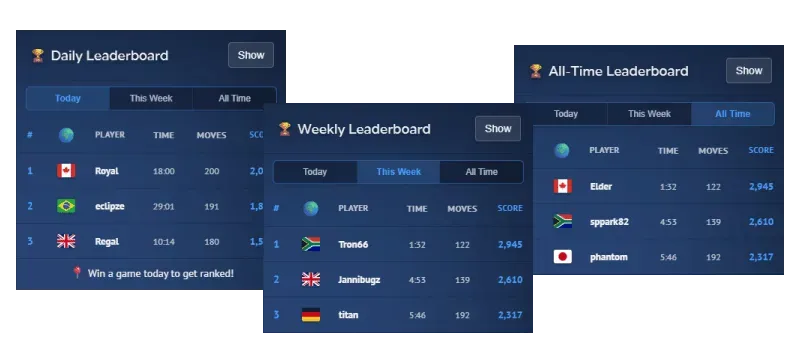
Yes. Solitaire Mastery runs free daily, weekly and all-time leaderboards for Klondike, Spider and FreeCell, with a competitive scoring system that ranks every completed game — no account or download required. Your score is submitted automatically when you win, and you can see where you placed straight away.
Competitive scoring here means your result is a composite of four things rather than a single number:
- Base score — points earned for foundation moves, turnovers and efficient play
- Time bonus — faster completions score higher, but speed alone won't top the board
- Move efficiency — fewer moves for the same win means a better score
- Difficulty modifier — Draw 3 and Hard deals are weighted above Draw 1 and Easy
The Daily Challenge is the most directly competitive mode: every player gets the same seeded deal that day, so the leaderboard measures skill on identical cards rather than luck of the shuffle. For the exact point values behind each of these components, see how Klondike Solitaire scoring works.
What Is a Solitaire Leaderboard?
A solitaire leaderboard is a ranking system that compares players based on performance metrics such as score, time, efficiency, and difficulty level.
Unlike casual play, leaderboard modes are designed to:
- Reward skill over luck
- Normalize scores across difficulty levels
- Prevent manipulation or farming
- Encourage replayability and mastery
On SolitaireMastery, leaderboards are built to reflect true Klondike skill, not just speed or grinding.
How Solitaire Leaderboards Calculate Rankings
Most modern solitaire leaderboards rely on a composite score, not a single metric. This prevents players from gaming the system by optimizing just one aspect of their play.
Common Ranking Factors
Here's what typically contributes to your leaderboard position:
-
Base Score
Earned from standard actions such as moving cards to foundations or uncovering hidden cards. For a detailed breakdown, see our Klondike Solitaire Scoring guide. -
Time Taken
Faster completions generally score higher — but only when balanced with good play. -
Move Efficiency
Fewer unnecessary moves equals better efficiency. Cycling the stock endlessly or making redundant tableau moves will hurt your ranking. -
Difficulty Modifier
Harder games multiply your final score to reward the increased challenge. -
Game Mode
Draw 3 typically ranks higher than Draw 1 due to its significantly lower win rate and strategic depth.
Why Composite Scoring Matters: Using multiple factors prevents exploitation. Players can't just rush through easy games or grind the same strategy repeatedly. They must balance speed, efficiency, and difficulty to climb the rankings.
Why Difficulty Modifiers Matter
Without difficulty modifiers, leaderboards would be fundamentally unfair. A fast Draw 1 game is not equal to a solid Draw 3 game — and competitive rankings must reflect that reality.
Typical Difficulty Multipliers
| Game Mode | Difficulty | Score Multiplier |
|---|---|---|
| Draw 1 | Easy | ×1.0 |
| Draw 3 | Medium | ×1.5–2.0 |
| Expert Rules | Hard | ×2.5+ |
This scoring system ensures:
- Skilled players are rewarded for tackling harder challenges
- Easy-mode grinding doesn't dominate rankings
- Competitive integrity remains intact across all skill levels
To understand the differences between game modes, check out our detailed comparison: Draw 1 vs Draw 3 Klondike Solitaire.
Time vs Skill: What Really Wins?
Many players assume speed alone wins leaderboards. It doesn't. While time is a factor, it's balanced against efficiency and decision quality.
High-Ranking Players Balance:
- Fast decision-making (not rushed play)
- Minimal wasted moves
- Foundation timing discipline
- Strategic tableau sequencing
A slower game with excellent efficiency often outranks a rushed, sloppy one. The best players think quickly and accurately — they don't sacrifice one for the other.
For strategies that improve both speed and accuracy, see our comprehensive Klondike Solitaire Strategy guide.
Speed Without Strategy Fails: If you're making fast moves but cycling through the stock repeatedly or missing obvious foundation opportunities, your efficiency score will be terrible — and so will your ranking.
Draw 1 vs Draw 3 on Leaderboards
Most competitive leaderboards either separate Draw 1 and Draw 3 rankings, or apply strong difficulty multipliers to Draw 3 scores.
Why the Separation Matters
- Win rate difference: Draw 3 has a significantly lower win rate (15-20%) compared to Draw 1 (80%)
- Strategic depth: Draw 3 requires forward planning and memory of hidden cards
- Skill expression: Draw 3 reduces the impact of luck and rewards skillful play
Because of these differences, serious competitive players typically focus on Draw 3 mode for leaderboard climbing. It's harder, but it also offers more opportunities to demonstrate skill over luck.
Competitive Leaderboards on SolitaireMastery
Our leaderboard system puts these principles into practice with three competitive timeframes designed to reward both consistency and peak performance.
Leaderboard Features
- Daily Leaderboard: Fresh competition every 24 hours. Perfect for testing new strategies and competing on even ground.
- Weekly Leaderboard: Balanced timeframe that rewards consistency while allowing for skill improvement throughout the week.
- All-Time Leaderboard: Hall of fame for the best players ever. Long-term skill and dedication determine who reaches the top.
- Difficulty-Adjusted Scoring: Draw 3 games receive higher score multipliers to ensure fair competition across game modes.
- Real-Time Updates: Rankings update instantly as games complete, keeping competition dynamic and engaging.
- Anti-Cheat Protection: Automated validation ensures every score is legitimate and earned through skill.
Ready to compete? Play Klondike Solitaire now and see where you rank against players worldwide.
How Anti-Cheat Systems Protect Leaderboards
Trust is everything in competitive solitaire. Well-designed leaderboards include multiple layers of protection to ensure fair play.
Common Anti-Cheat Measures
- Impossible score detection: Flags scores that exceed mathematical limits
- Move/time ratio validation: Identifies suspiciously fast move sequences
- Session integrity checks: Detects interrupted or manipulated game sessions
- Duplicate-pattern detection: Identifies repeated identical games or exploits
These systems ensure that:
- Legitimate players are rewarded fairly
- Exploits and cheats don't corrupt rankings
- Leaderboards remain meaningful and competitive
Fair Play Builds Trust: Competitive leaderboards only work when players trust the system. Anti-cheat measures protect the integrity that makes climbing the rankings meaningful.
How to Rank Higher on Solitaire Leaderboards
Here's what consistently works for top-ranked players.
1. Play the Right Mode
If your goal is ranking — not relaxation — play Draw 3 with timed scoring. The difficulty multiplier makes every win count significantly more.
2. Optimize, Don't Rush
Speed matters after efficiency. Avoid these common efficiency killers:
- Cycling stock unnecessarily
- Premature foundation moves that block tableau options
- Dead-end tableau stacking
3. Learn When Not to Move Cards
Top players often pause intentionally to preserve future options. Just because a move is legal doesn't mean it's optimal. Our strategy guide covers this concept in detail.
4. Replay with Purpose
Replaying the same deal to understand mistakes builds ranking skill faster than random games. Analyze where you lost time or made inefficient moves, then improve.
5. Know the Scoring System
If you don't understand how points are calculated, you're playing blind. Study the scoring system to know which actions maximize your score.
Mastery Through Practice: The difference between casual and competitive play is intentionality. Every move should have a purpose, and every game should teach you something new.
Are Solitaire Leaderboards Skill-Based?
Yes — when designed correctly.
While luck affects individual deals, long-term leaderboard dominance is skill-based. Over time, stronger players consistently rise because:
- They win harder games more consistently
- They score more efficiently per move
- They avoid low-value actions that waste time
- They recognize patterns faster
Individual games may be unwinnable due to shuffling, but across hundreds of games, skill becomes the dominant factor. The best players extract maximum value from every winnable deal.