Solitaire win rate statistics: what percentage of games are winnable?
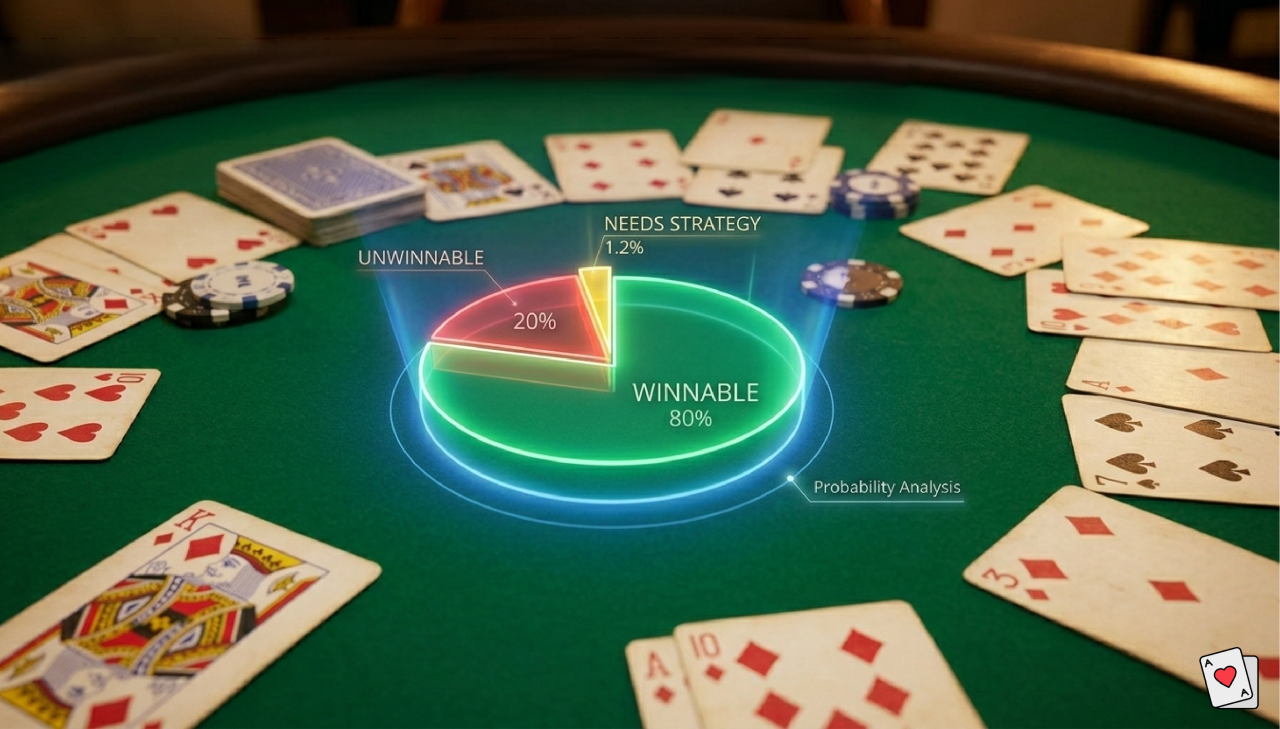
Roughly 79% of Klondike Draw 1 deals are theoretically winnable — meaning a perfect player with perfect information could solve them. In practice, experienced players win about 55–65% of games. The gap between those two numbers is where all the strategy actually matters.
These aren't guesses. Researchers have analyzed Klondike computationally, and the numbers have held up across multiple studies. What varies is how skill, draw mode, and game variant affect what you'll actually see in your win/loss record.
What percentage of Solitaire games are winnable?
The answer depends heavily on which variant you're playing and how you count "winnable."
For Klondike Draw 1, approximately 79% of deals can be solved with optimal play. That 79% figure assumes you can see all cards and make perfect decisions — so it's a ceiling, not an average. Real players, working with face-down cards they can't see, win about 55–65% of the time at a skilled level. Beginners often see 20–35%.
Klondike Draw 3 is more complicated. Theoretically, about 82% of Draw 3 deals are solvable — slightly higher than Draw 1, because having access to more of the deck at once opens up more paths. But the practical win rate drops to 40–50% even for good players. The 3-at-a-time constraint buries cards in ways that are genuinely hard to manage without planning several cycles ahead.
Spider Solitaire 1-suit is close to 100% winnable with competent play. The single-suit constraint means sequences form easily and there's rarely a true dead end.
Spider 4-suit is where things get brutal. Even expert players solve only 10–15% of deals. The requirement that sequences be same-suit creates dependency chains that collapse more often than not.
FreeCell is the outlier: approximately 99.999% of deals are solvable. Of the 32,000 standard deals in the classic Windows FreeCell deck, only one — Deal #11982 — has been proven unwinnable by exhaustive computer analysis.
Why Draw 3 has a lower practical win rate despite being "more theoretically winnable"
This trips people up. If Draw 3 has more theoretically winnable deals (82% vs 79%), why do players win less often?
The theoretical winnability figure assumes perfect play — including knowing exactly which card to play from the waste pile at each moment, and which cards are coming next in the stock. A real player doesn't know that. You see three cards flipped at once, only the top one is playable, and you have to burn through multiple stock cycles before you even see all 24 remaining cards once.
In Draw 1, every card in the stock becomes playable exactly once per cycle. In Draw 3, you might cycle through the stock three or four times before a specific card reaches the top of a three-card group at a moment when you can actually use it. That timing window is much smaller. The result: cards that are theoretically accessible are practically locked away for most of the game.
There's also a hidden information problem. Because Draw 3 requires more stock cycles to find needed cards, you spend more moves cycling — and each cycle is a move that didn't advance the tableau. The game runs out of useful moves faster than it seems like it should.
How skill affects your Solitaire win rate
Skill matters more in Klondike than most casual players realize. The skill floor is low — you can learn the rules in five minutes — but the skill ceiling is surprisingly high.
A complete beginner playing Draw 1 might win 20–30% of games. They'll move cards to foundations too early, miss that a face-down tableau card is more important than a foundation point, and burn through the stock without a plan.
With basic strategy — prioritizing face-down card exposure over foundation moves, not filling empty columns with the first King available — you can realistically push to 45–55%. That's a substantial jump for what amounts to a few key habits.
Advanced players who plan ahead 3–5 moves, carefully manage empty columns, and use undo to explore alternative paths reach 60% and above in Draw 1. Beyond that, you're bumping against the 79% theoretical ceiling — the remaining 20% of games genuinely cannot be won no matter what.
For specific techniques, the Klondike Solitaire strategy guide covers move prioritization and planning in detail.
What makes a deal theoretically unwinnable?
The ~21% of Klondike deals that can't be won aren't just "hard" — they're mathematically stuck. Understanding why helps calibrate when to keep trying and when to start over.
The most common cause is circular dependencies. Card A needs to move to a certain position, but doing so requires card B to move first. Card B, however, can only move once card A is out of the way. Neither can go first, so neither can go at all. This creates a deadlock that no amount of clever sequencing can break.
The second common cause is buried low cards. If all four Aces are under long face-down columns with no alternative paths to expose them, you can't start the foundations. And if you can't start the foundations, you can't free up space in the tableau, which means those columns never get shorter. The game is stuck from the first move.
A third pattern involves stock exhaustion. If the waste pile cycles repeatedly with no progress possible in the tableau, and no foundation moves are available, you hit a hard wall. The game keeps showing you the same unplayable cards in the same order.
None of these are edge cases. Together they account for roughly 1 in 5 Klondike deals.
Win rates by difficulty setting
Not all Solitaire implementations use the same shuffle. In Solitaire Mastery, the difficulty setting directly affects your win rate by changing how the deck is arranged before the deal.
Easy mode uses a custom shuffle algorithm that prioritizes accessible Aces and low cards. After the initial deal, the algorithm checks where the 2s, 3s, and low-rank cards landed. If they're buried deep in tableau columns 3 through 7, it swaps them out with random stock cards to bring them closer to the surface. Tableaus 5, 6, and 7 are also sorted in roughly descending order — Kings near the top, lower cards below — which makes sequences easier to form. The result is a noticeably higher win rate by design.
Medium mode is a standard Fisher-Yates shuffle. Fully random. Win rates match the theoretical ~55–65% range for skilled players.
Hard mode does the opposite of Easy. The shuffle algorithm deliberately tries to bury critical cards and create the kinds of dependency chains that cause unwinnable situations. Expect your win rate to drop significantly — this mode is for players who want a genuine challenge rather than a probability-adjusted game.
FreeCell: the exception to everything
FreeCell is the most skill-dependent solitaire variant for one simple reason: you can see every card from the first move. No hidden information, no guessing what's face-down in a tableau pile.
The four free cells let you temporarily park cards that are in the way, which gives you enough flexibility to work around almost any initial arrangement. Computer programs have solved all 32,000 standard deals and found exactly one that cannot be won: Deal #11982.
Deal #11982 wasn't discovered by a player stuck on a hard game. It was found through automated exhaustive search — software that tried every legal sequence of moves and confirmed none of them produced a solution. That's a different kind of certainty than "I couldn't figure it out."
The practical consequence: if you're playing standard FreeCell and you can't find a solution, you're almost certainly missing a move. Unlike Klondike, giving up on a FreeCell game because it "seems unwinnable" is almost always premature.
How to improve your win rate
These are the changes that move the needle most, especially for players in the 30–50% range:
- Expose face-down cards before anything else. Every face-down card in the tableau is information and mobility you don't have yet. Foundation moves feel productive, but they often cost tempo that revealing tableau cards would have given back tenfold.
- Don't rush empty columns. An empty column is one of the most powerful resources in the game. Filling it with a random King wastes it. Hold it open until you have a specific move that needs the temporary space.
- Play Draw 1 first. Get comfortable with the rules and strategy where you can see your progress. Draw 3 teaches bad habits early because the feedback loop is so much slower.
- Use undo as a learning tool. If a sequence of moves leads somewhere stuck, back up and try the other branch. Over time you start seeing which paths end badly without needing to play them out.
- Recognize unwinnable games early. Once you've cycled the stock two or three times with no tableau or foundation progress, the odds are high the deal can't be won. Starting fresh isn't giving up — it's keeping your time for games that are actually solvable.
For a deeper look at each of these, the full strategy guide goes through move prioritization and planning in detail.