The history of Solitaire: origins, evolution & the Windows era
Solitaire has been played for more than 200 years. It predates the railroad, the photograph, and the telephone. Today it's probably the most-played card game in human history — not because it was always popular, but because one product decision by a small team at Microsoft in 1990 put it in front of hundreds of millions of people who had never touched a deck of cards alone.
How a German card game from 1783 ended up on 90% of the world's personal computers is worth understanding.
Where did Solitaire come from?
The earliest known written reference to Solitaire appears in a 1783 German game compendium, where it's described as a card game played alone. The word used was Patiencespiel — patience game — and that name stuck in most of Europe. The British called it Patience for the next two centuries. Americans eventually settled on Solitaire, from the French word for alone.
The exact origins are murky, as they tend to be for games that passed between people orally before anyone thought to write them down. The leading theories place the birth somewhere in Northern Europe — most likely Germany or Scandinavia — in the mid to late 18th century. Some historians have proposed that the game evolved from cartomancy, the practice of using playing cards for fortune-telling. Laying out cards in patterns, interpreting their positions and relationships, then watching how the layout resolved — it's not hard to see how that could become a game.
What's clear is that by the early 19th century, Patience had spread across Europe. Napoleon is frequently cited as a devoted player during his exile on Saint Helena (1815–1821). Whether this is true or embellished is hard to verify, but the association stuck — several Solitaire variants are still named after him. By the 1840s, Patience had reached Britain, where it became a fashionable indoor pastime, especially among women, who were expected to occupy themselves quietly in polite society.
The 19th century: codification and variants
As Patience spread, it splintered. Players invented new layouts, new rules, and new challenges, and word of interesting variants passed from household to household without any central authority to standardize them. By mid-century the number of recognized variants was already in the dozens.
The first major attempt to document the game came in 1870, when Lady Adelaide Cadogan published Illustrated Games of Patience in London — the earliest known English-language book dedicated to the subject. It described 25 distinct variants. Other compilations followed, and each successive volume added more. By the early 20th century, books cataloguing 100 or more Patience variants were common.
The variant we now call Klondike appears to have emerged in the late 19th century, likely in North America. It was already popular in Canada and the United States by the 1880s, possibly connected to the Klondike Gold Rush of 1896–1899 — though that association may be coincidental. The game appeared in American card game compendiums of that era under various names, including Canfield and Fascination, before Klondike became the dominant term.
Spider Solitaire was first documented around the same period, also in North America. FreeCell came much later: it was invented in its modern form by Paul Alfille in 1978, though earlier patience variants with a similar "reserve" mechanic date to the 19th century.
The 20th century: from parlour to PC
Through the first half of the 20th century, Solitaire remained what it had always been: a game you played with a physical deck of cards on a flat surface. It was popular — card game books sold well, and Patience was a well-known pastime — but it had no particular cultural dominance. Bridge, Poker, and Rummy commanded more serious players. Patience was what you did on a rainy afternoon when no one else was around.
That changed in 1990.
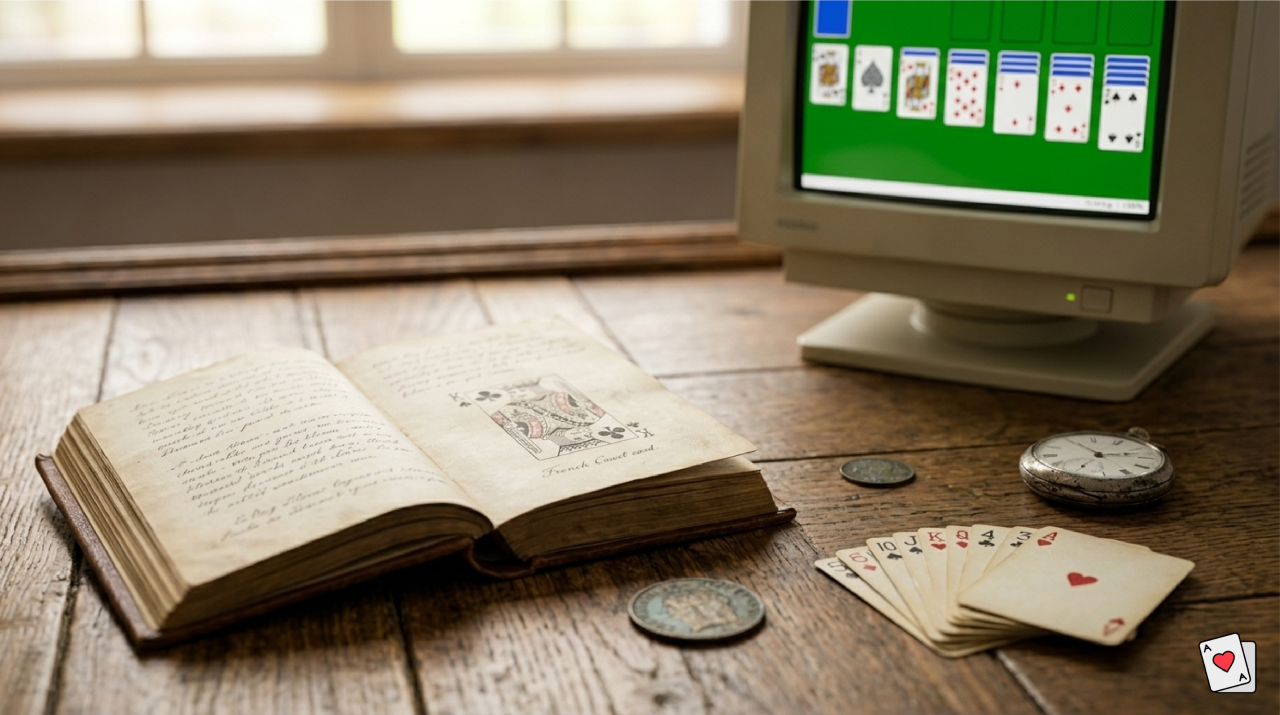
Microsoft Windows 3.0 launched that year, and bundled alongside it was a game called Solitaire. The game was written by Wes Cherry, a Microsoft intern, based on an earlier version built by Susan Kare — the designer responsible for much of the original Macintosh visual language. The decision to include it wasn't about entertainment. The game was included as a teaching tool: a low-stakes, intuitive way for new users to practice using a mouse. Drag and drop, click-to-select, moving objects across a screen — all of it felt more approachable when the stakes were a card game rather than a work document.
It worked. Windows 3.0 sold three million copies in its first six months. Solitaire was on all of them. A generation of office workers who had never played a single hand of Patience on a physical table spent lunch breaks and quiet afternoons playing Klondike on a screen.
Windows Solitaire: the numbers
At its peak in the early 2000s, Microsoft estimated that Windows Solitaire was being played by more than 35 million people per day. A survey of office IT departments found it was consistently the most-used application on corporate networks — more than email, more than word processors, more than anything else installed.
Microsoft's own research suggested that Solitaire had been played more hours than any other software application in history. The company removed it from Windows 8 in 2012, then quietly brought it back as a free download after the response made clear how much people missed it. It was reinstated as a pre-installed app in Windows 10.
The Windows era also introduced FreeCell to a mass audience. Microsoft added FreeCell to Windows 95, giving it the numbered-deal system and the interface that most people still picture when they think of the game. Spider Solitaire came with Windows 98. By 2000, all three of the major Solitaire variants had been in the hands of hundreds of millions of people.
Why Solitaire endures
The obvious answer is habit. Hundreds of millions of people learned Solitaire on a Windows computer, and that familiarity never really goes away. When smartphone apps emerged, Solitaire was one of the first categories to fill up. When browser games appeared, Solitaire variants were among the most popular. The audience was already there.
But familiarity alone doesn't explain why people still play. There are plenty of games people grew up with that they don't return to. Solitaire has something structural going for it.
A game runs 5 to 20 minutes. There's a clear win condition. You can see at a glance whether you're making progress. It takes enough attention to quiet a restless mind without demanding the kind of focus that makes it feel like work. You can play it while listening to something. Stop mid-game and come back later. No one else has to be available or interested. The ask is low.
And there's the tension. Every game involves a real question: can I win this? Klondike is genuinely uncertain — about 21% of deals are unwinnable, and you often can't tell which kind you're playing until the game is nearly over. That uncertainty keeps you engaged. You're not just executing a procedure; you're trying to solve a problem that might not have a solution.
The satisfaction of a completed foundation — cards snapping into place, the game acknowledging that you got there — taps into something simple and reliable. It doesn't require practice to feel good. It doesn't require other people. It's available to anyone, anywhere, at any time.
Solitaire in the mobile era
The iPhone launched in 2007. Within months, Solitaire apps were among the top-downloaded applications on every mobile store. The format suited mobile perfectly: short sessions, portrait orientation, touch controls that feel more natural than a mouse for moving cards. Microsoft Solitaire Collection launched for iOS and Android and became one of the most-downloaded free apps in both stores.
Mobile changed who plays Solitaire as much as how they play it. The Windows era was heavily skewed toward office workers at desks. Mobile opened it to commuters, students, people in waiting rooms, parents stealing five minutes after bedtime. The audience expanded considerably, and the game stayed essentially the same.
Online Solitaire added leaderboards, daily challenges, and competitive elements that the physical card game never had. Now you're not just trying to win — you're trying to win faster, or with fewer moves, or against a daily seed that everyone else played the same day. The bones of the game are still Cadogan's 1870 compendium. The scaffolding around it is very much a product of the 21st century.
More than 200 years later
Solitaire is an old game that got a second life it probably didn't deserve, statistically speaking. Most games from the 18th century are historical footnotes. This one is something people played yesterday, and will play today, for reasons that are basically the same as whoever dealt out that first hand in 1783: because it's there, because it passes the time, because there's something satisfying about imposing order on a shuffled deck.
The cards are pixels now instead of pasteboard. The game is the same. Not many things make it across three centuries.